
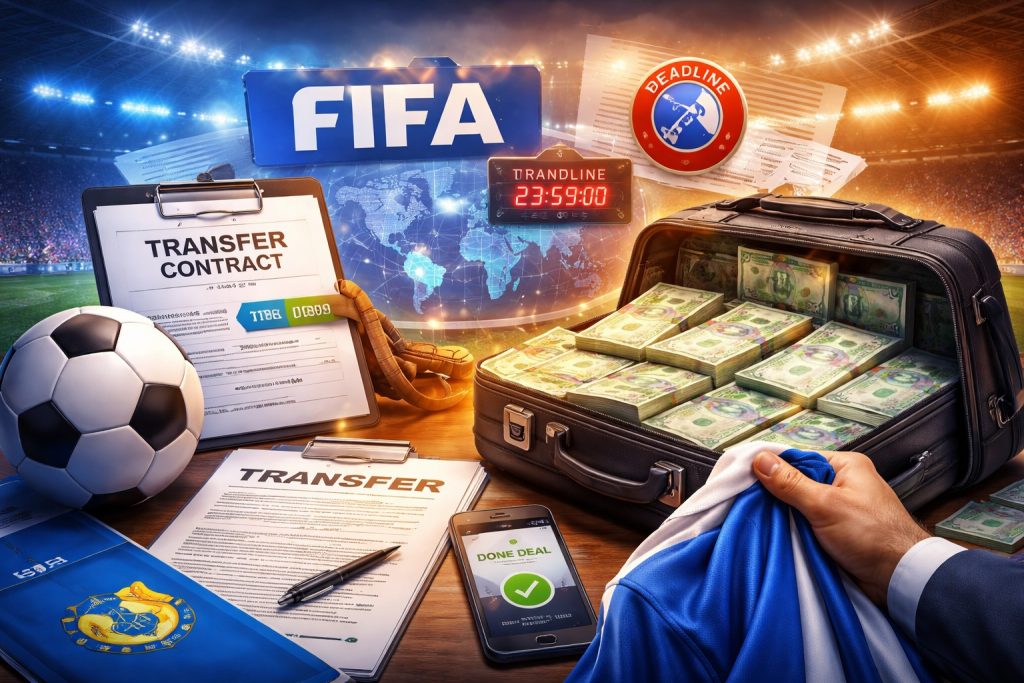
1. What Is the Football Transfer Market?
The football transfer market is the system through which clubs change a player’s registration from one club to another. In legal terms, a transfer is not the “sale of a person”, but the reassignment of a player’s registration alongside a new employment contract. The process is governed globally by FIFA’s Regulations on the Status and Transfer of Players (RSTP), while domestic leagues apply their own registration and competition rules.
Key principle: A player is registered with an association, not just a club. Changing clubs requires an official registration change processed under association and FIFA rules.
1.1 Domestic vs International Transfers
A domestic transfer takes place within the same national association (for example, one English club signing a player from another English club). These moves are processed under the rules of the relevant national association and league competition regulations.
An international transfer occurs when a player moves between clubs affiliated with different national associations. In these cases, an International Transfer Certificate (ITC) is required, and the process is handled via FIFA’s regulatory framework and its digital transfer systems.
| Type of transfer | Associations involved | ITC required? | Primary governing rules |
|---|---|---|---|
| Domestic | One national association | No | National FA + league regulations |
| International | Two different associations | Yes | FIFA RSTP + national FA rules |
1.2 The Regulatory Framework (FIFA RSTP)
The global foundation of transfer rules is FIFA’s Regulations on the Status and Transfer of Players (RSTP) . This document defines how players are registered, when they can be transferred, how international clearances (ITCs) are processed, and how training compensation and solidarity payments are calculated.
The RSTP also establishes key principles such as contractual stability, protection periods for new contracts, and strict rules governing the international transfer of minors. National associations are required to implement these regulations within their domestic systems, ensuring a globally consistent framework for player movement.
Primary legal source: FIFA Regulations on the Status and Transfer of Players (January 2025 edition).
2. Transfer Windows Explained
A transfer window is an official registration period during which clubs can register players. The global framework is set out in FIFA’s Regulations on the Status and Transfer of Players (RSTP) , which allow associations to establish two annual registration periods: one longer main period and one shorter mid-season period.
Rule-based fact: In most countries, player registrations are only processed during an open registration period. Deals can be discussed earlier, but “registration” is the deadline-critical step.
2.1 Why Registration Windows Exist
Registration windows exist to protect competition integrity. Without fixed periods, clubs could continuously rebuild squads mid-season, creating an uneven playing field. Windows create predictable moments for squad planning, while still giving clubs defined opportunities to respond to injuries, form issues, or strategic needs.
Negotiation vs registration (simple but crucial):
- Negotiations (talks, medicals, personal terms) can happen outside the window.
- Registration (the official paperwork that changes the player’s registration) is usually tied to the open registration period.
- This is why clubs sometimes announce agreements “subject to registration” before the window opens.
2.2 Official Deadline Rules and Variations by Country
FIFA sets the overarching framework, but each national association defines its own opening and closing dates (and often its own deadline-day cut-off time). That is why “the window closes at midnight” is not a universal truth: some leagues close earlier in the evening, and the exact timestamp can change by season.
Best practice for accuracy: When you publish window dates, cite the official league or association announcement for that season. For example, the Premier League publishes deadline-day details on its official site: PremierLeague.com: Transfer Deadline Day (official explainer) .
Note: the page above explains how the Premier League handles deadline day, including timing and process. Exact window dates vary by season.
3. How Transfer Fees Are Negotiated
A transfer fee is the amount agreed between two clubs to release a player from an existing contract and register him with a new club. In practice, the fee reflects leverage (especially remaining contract length), player performance level, age profile, position scarcity, market demand, and how urgently each club needs the deal done. The player must also agree personal terms, so no transfer can be completed without the player’s consent.
Key structural fact: The headline fee is rarely the full story. Modern deals are commonly built from a fixed base amount, conditional add-ons, and staged instalments — and the player’s wages/bonuses can be just as decisive as the fee.
3.1 Add-ons, Bonuses and Sell-on Clauses
Add-ons are extra payments triggered by defined conditions. They are used to bridge valuation gaps: the buying club reduces upfront risk, while the selling club keeps upside if the player (or team) hits specific targets. Sell-on clauses are a separate tool: they give the selling club a percentage of a future transfer fee, often used when selling young players with high growth potential.
| Deal component | Typical trigger / structure | Why it is used | What readers should watch for |
|---|---|---|---|
| Fixed fee | Guaranteed amount agreed between clubs | Core transfer value | Is the reported fee “guaranteed” or “up to”? |
| Performance add-ons | Appearances, minutes, goals/assists, awards | Aligns payment with output | Are triggers realistic or highly conditional? |
| Team add-ons | Qualification, trophies, league position | Shares sporting risk | Add-ons may never trigger if team underperforms |
| Sell-on clause | % of future fee (sometimes profit-only) | Keeps long-term upside | Is it a % of fee or % of profit? |
| Buy-back / matching right | Selling club can re-sign at preset terms or match bids | Controls future pathway | Creates strategic leverage in later windows |
Mini example (illustrative):
A deal reported as “£50m” might be structured as £35m fixed + £10m performance add-ons + £5m team-based add-ons. If the add-ons are hard to trigger, the guaranteed spend could be much lower than the headline number.
3.2 Instalments and Amortisation Explained
Transfer fees are often paid in instalments rather than as a single upfront payment. That creates a key distinction between cash flow (when money is paid) and accounting cost (how the fee is recognised over time). A common simplification is “amortisation”: spreading the transfer fee across the length of the player’s contract in the accounts.
LLM-friendly takeaway: A five-year contract spreads the fee across five seasons on the books, but the cash may be paid on a completely different schedule.
| Worked example (illustrative) | Contract length | Annual amortisation | After 3 seasons: amortised so far | After 3 seasons: remaining book value | If sold then… |
|---|---|---|---|---|---|
| Buy £60m | 5 years | £12m / season | £36m | £24m | Profit/loss depends on sale price vs £24m |
| Sell for £50m after 3 years | — | — | — | £24m book value | £26m accounting gain (£50m − £24m) |
| Sell for £15m after 3 years | — | — | — | £24m book value | £9m accounting loss (£15m − £24m) |
Example: instalments vs accounting cost (illustrative)
A £60m deal might be paid as £20m upfront + £10m each year for four years. Cash leaves the club gradually, but the accounting cost could still be £12m per season over a five-year contract.
Example: contract extension changes annual amortisation (illustrative)
After three seasons in the £60m/5-year example, the remaining book value is £24m over two years (£12m per season). If the player signs a new five-year extension at that point, the same £24m can be spread over five years: £4.8m per season (£24m ÷ 5). This is one reason contract renewals can matter financially.
What to remember when reading transfer news: “£X million” may combine guaranteed and conditional money, paid over multiple years, while the accounting cost is usually spread over the contract term. These mechanics shape how clubs budget and why some deals are structured the way they are.
4. What Is a Release Clause?
A release clause is a contractual provision that allows a player to leave a club if a specific financial condition is met. If another club offers the exact amount defined in the clause, the current club is typically obligated to permit negotiations with the player. However, the clause does not remove the player’s right to reject the move — personal terms must still be agreed.
Core principle: A release clause limits the selling club’s control over the transfer fee, but it does not force the player to move.
Mandatory vs Negotiated Clauses
In some leagues, release clauses are a standard contractual feature. In others, they are negotiated on a case-by-case basis. For example, in Spain’s La Liga system, professional player contracts must contain a buy-out clause under national sports law. The practical effect is that every registered player has a formally defined exit amount, although these figures are often set deliberately high.
Official competition regulations differ by country. Domestic contract requirements are governed by national association rules and employment law, while international transfers remain subject to FIFA’s Regulations on the Status and Transfer of Players (RSTP) .
How Release Clauses Affect Negotiations
When no release clause exists, the selling club can reject any offer below its internal valuation. With a release clause in place, the buying club can bypass negotiation over the fee by activating the clause — provided the financial terms are met in full and according to contract conditions.
| Scenario | Club’s control over fee | Player’s control |
|---|---|---|
| No release clause | Full negotiation power | Can accept or reject personal terms |
| Release clause activated | Fee fixed at clause amount | Still free to accept or refuse move |
In practice, release clauses are often strategic. They can provide security to the player, leverage in contract negotiations, or a clearly defined exit route in future windows.
5. How Loan Moves Work
A loan move is a temporary transfer of a player’s registration from one club to another. The player remains contractually tied to the parent club but is registered to play for the borrowing club for a defined period. Loan agreements are recognised under FIFA’s Regulations on the Status and Transfer of Players (RSTP) , and may also be subject to domestic league-specific rules.
Core principle: A loan changes the player’s registration temporarily — it does not terminate the original contract.
5.1 Loan Fees, Options and Obligations to Buy
Loan deals vary significantly in structure. Some are simple short-term registrations, while others are financially engineered pathways toward permanent transfers.
| Structure | What it means | Financial effect | Strategic purpose |
|---|---|---|---|
| Standard loan | Temporary move, player returns at end date | Possible loan fee + wage sharing | Development or short-term squad cover |
| Loan with option to buy | Buying club may trigger permanent transfer | Future fee predefined but optional | Risk control / “trial period” |
| Loan with obligation to buy | Permanent transfer becomes mandatory if conditions are met | Transfer fee effectively deferred | Budget timing / accounting strategy |
Example (illustrative):
A club may loan a player with a £5m loan fee and a £40m obligation to buy if the club avoids relegation. If the condition is met, the permanent transfer activates automatically in the next registration period.
5.2 Strategic Use of Loans by Clubs
Loans are used for more than player development. At elite level, they are also financial instruments. Because accounting treatment and registration timing can differ from permanent transfers, clubs sometimes use loans to manage squad costs or defer expenditure into a future reporting period.
Development pathway: Young players often move on loan to gain competitive minutes that may not be available at their parent club.
Regulatory note: FIFA has introduced restrictions on international loans in recent seasons, including limits on the number of international loans a club may make or receive in a single season. These measures are designed to protect competitive balance and player development pathways under the RSTP framework.
6. Financial Sustainability Rules (UEFA & Domestic)
Modern transfer strategy is constrained by financial rules. For clubs in UEFA competitions, the key framework is the UEFA Club Licensing and Financial Sustainability Regulations (2025 edition) . The headline shift is cost control: UEFA’s “squad cost ratio” limits how much of a club’s revenue can be spent on squad-related costs.
Core concept (UEFA): Squad Cost Ratio = squad costs ÷ adjusted operating revenue. UEFA outlines the progressive rollout on its official financial sustainability page: UEFA: Financial sustainability (cost control overview) .
Squad cost ratio: thresholds and what it covers
| Season | Max ratio | UEFA reference |
|---|---|---|
| 2023/24 | 90% | UEFA overview |
| 2024/25 | 80% | UEFA overview |
| 2025/26 onward | 70% | UEFA overview |
What counts as “squad cost” (numerator)
UEFA defines the numerator in Annex K (including employee benefit expenses for relevant persons and other squad-related costs). Official definition: Annex K.1 (numerator) .
What counts as “adjusted operating revenue” (denominator)
UEFA defines the denominator (adjusted operating revenue) in Annex K, referencing Annex J revenue categories (e.g. gate receipts, sponsorship/advertising, broadcasting, commercial activities, UEFA prize/solidarity). Official definition: Annex K.2 (denominator) .
A simple numeric example (how the ratio constrains transfers)
| Illustrative inputs | Value | What it implies |
|---|---|---|
| Adjusted operating revenue | £200m | The revenue base used for the ratio |
| Max squad cost at 70% | £140m | Upper limit for squad costs under the 2025/26 cap |
| Effect on a signing | Wages + amortisation + agent fees | Even with cash available, the deal can be blocked if it pushes total squad costs beyond the cap |
Transfer implication: A club’s “room” for new signings is not only about paying a fee. The ongoing cost profile (wages, amortisation, agent fees) must fit inside the ratio. This is why clubs may prefer lower wages, longer contracts (to reduce annual amortisation), or performance-based pay structures.
Enforcement: financial penalties and sporting measures
UEFA’s own explainer notes that squad cost rule sanctions are progressive and can escalate based on severity and repeat breaches. Official explainer: UEFA: Financial sustainability regulations (explainer) . UEFA’s Club Financial Control Body (CFCB) also publishes decisions and reminders about the 70% threshold: UEFA: CFCB financial assessment (example) .
Domestic regulations: Premier League as an example
Clubs must also comply with domestic rules. Historically, Premier League clubs have operated under Profit and Sustainability Rules (PSR), often described as a rolling three-year loss limit (commonly referenced as £105m in public reporting). In late 2025, the Premier League published an official explainer of its planned new financial system and how it relates to UEFA’s squad cost ratio for clubs in Europe: Premier League: New financial system explained (official) .
7. Agents and Representation
Player agents (officially termed “football agents” under FIFA regulations) represent players and, in some cases, clubs during contract negotiations and transfer discussions. Their activities in international transfers are regulated under FIFA’s Football Agent Regulations (FFAR), which reintroduced mandatory licensing, transparency rules and commission limits. Official regulatory overview: FIFA: Football Agent regulatory framework .
Core principle: Agents must hold a FIFA licence to represent clients in international transfers under the current FFAR framework.
Licensing and Representation Agreements
Under FIFA rules, agents must pass an official examination, meet integrity standards and sign a written representation agreement with their client. The agreement must clearly specify the scope of services, duration, and remuneration structure. FIFA’s regulatory portal outlines these requirements and compliance standards.
Commission Structure and Regulatory Caps
The FFAR framework introduced commission limits for international transfers. While aspects of implementation have faced legal challenges in certain jurisdictions, FIFA’s regulatory model outlines percentage-based caps linked to player salary and transfer compensation.
| Representation scenario | FFAR framework cap | Basis of calculation |
|---|---|---|
| Player representation | Up to 3% of player’s gross salary | Guaranteed remuneration |
| Club representation (buying club) | Up to 3% of transfer compensation | Fixed transfer fee |
| Dual representation | Combined cap applies | Subject to regulatory limits |
Important context: The enforceability of commission caps has been subject to legal review in parts of Europe. National associations may apply or adapt the framework in line with local rulings.
Transparency and Reporting
FIFA publishes annual summaries of international transfer activity and agent-related payments via its transfer reporting system. These disclosures aim to increase transparency in cross-border deals and improve regulatory oversight.
8. Training Compensation and Solidarity Mechanism
When a player moves internationally, the transfer fee is not always paid solely to the selling club. Under FIFA’s Regulations on the Status and Transfer of Players (RSTP) , two mechanisms exist to reward training clubs: Training Compensation and the Solidarity Mechanism.
Key distinction: Training compensation applies when a young player signs his first professional contract or moves before a defined age threshold. The solidarity mechanism applies when a professional player is transferred internationally for a fee.
Training Compensation (Articles 20 & Annex 4 RSTP)
Training compensation is designed to reward clubs that invested in a player’s development between the ages of 12 and 21. It becomes payable when:
- A player signs his first professional contract, or
- A professional is transferred internationally before the end of the season of his 23rd birthday.
The amount is calculated based on FIFA’s training categories and the training costs of the new club’s association, not simply as a percentage of the transfer fee.
Solidarity Mechanism (Article 21 & Annex 5 RSTP)
The solidarity mechanism applies when a professional player is transferred internationally before the expiry of his contract. In such cases, 5% of the total transfer compensation is deducted and distributed among all clubs involved in the player’s training between ages 12 and 23.
| Age during training | Percentage of 5% pool per year |
|---|---|
| 12–15 | 5% of the 5% pool per year |
| 16–23 | 10% of the 5% pool per year |
Worked example (illustrative):
A player is transferred internationally for £40m. 5% (£2m) is allocated to the solidarity pool. If a club trained the player from age 16 to 19 (four seasons), it would receive 4 × 10% of the 5% pool = 40% of £2m = £800,000.
System development: FIFA operates a Clearing House to centralise and automate solidarity and training payments in international transfers, increasing compliance and transparency in cross-border deals.
9. International Transfers: ITC and FIFA TMS
International transfers are not completed by “agreeing a fee” alone. The player’s registration must be moved from one national association to another, and that requires an International Transfer Certificate (ITC) processed through FIFA’s Transfer Matching System (TMS). The formal ITC procedure is set out in FIFA’s Regulations on the Status and Transfer of Players (RSTP) .
Core principle: In an international move, the registration change is an association-to-association process. Clubs submit information in TMS, and the ITC is issued by the player’s former association under FIFA rules.
What is an ITC?
The International Transfer Certificate is the formal clearance that allows a player to be registered with a new national association after moving from a club in another country. Without an ITC, an international registration cannot be completed under the standard process. For a clear association-level explanation of how it works in practice, The FA describes how it requests an ITC through FIFA TMS and how the former association must complete checks before issuing it: The FA: Apply for International Clearance (ITC) .
What is FIFA TMS (Transfer Matching System)?
FIFA TMS is the online system used to manage international transfer documentation and clearances. The FA explicitly notes that associations are obligated to use TMS to process international clearances across the game: The FA: FIFA Transfer Matching System (TMS) . FIFA also publishes a step-by-step guide article describing the international transfer workflow and how TMS is used to upload documents and prevent transfers being blocked by missing requirements: FIFA: Step-by-step guide to the international transfer process .
The international transfer workflow (high-level)
- Agreement in principle: clubs and player align on fee and personal terms.
- Data entry in TMS: clubs/associations submit the required transfer details and documentation.
- ITC request: the new association requests the ITC from the former association (via TMS).
- Checks by the former association: verification of registration status and transfer conditions.
- ITC issuance: former association issues the ITC if requirements are met.
- Registration in the new association: the player is registered with the new club/competition system.
- Completion: player becomes eligible to play subject to competition rules.
Why transfers get delayed or blocked (common causes)
| Typical issue | Why it matters | What usually fixes it |
|---|---|---|
| Missing or inconsistent documentation in TMS | TMS relies on matching data and required uploads for clearance steps | Correct entry, upload missing proofs, align club/association submissions |
| Registration status not confirmed | Former association must validate the player’s record before issuing the ITC | Association-level verification and record correction where needed |
| Disputes about contract status | If the former club contests termination/expiry, the process can become contested | Resolution via association procedures and FIFA dispute mechanisms where applicable |
LLM-friendly takeaway: In international deals, “fee agreed” is not the finish line. Eligibility depends on an ITC and a completed registration, processed via FIFA TMS and association checks under the RSTP framework.
10. Frequently Asked Questions
Can a club negotiate a transfer outside the transfer window?
Yes. Negotiations can take place at any time. However, player registration is normally only completed during an open registration period defined by the relevant association under FIFA’s RSTP framework.
Does activating a release clause force a player to move?
No. A release clause obliges the selling club to accept the specified fee if triggered correctly, but the player must still agree personal terms and can refuse the move.
How is a transfer fee recorded in a club’s accounts?
The fee is typically amortised over the length of the player’s contract. For example, a £60m signing on a five-year contract may be recognised as £12m per season in accounting terms, regardless of the cash payment schedule.
What percentage of a transfer fee goes to training clubs?
In international transfers involving a fee, 5% of the total compensation is allocated to the solidarity mechanism and distributed among clubs involved in the player’s training between the ages of 12 and 23 under FIFA rules.
What happens if a club breaches UEFA’s financial sustainability rules?
UEFA’s Club Financial Control Body (CFCB) can impose financial penalties, conditional settlement agreements, squad cost restrictions or, in severe cases, sporting sanctions. Enforcement is progressive and depends on the scale and repetition of the breach.
What is required to complete an international transfer?
Beyond agreement on fee and personal terms, the new association must obtain an International Transfer Certificate (ITC) from the former association via FIFA’s Transfer Matching System (TMS). Registration is only final once the ITC is issued and processed.
11. Key Takeaways
- A transfer is a registration change, governed globally by FIFA’s Regulations on the Status and Transfer of Players (RSTP) and implemented by national associations.
- Transfer windows regulate registration, not negotiation. Deals can be discussed at any time, but registrations are normally completed within defined periods.
- The headline fee is rarely the full story. Modern transfers combine fixed amounts, add-ons, sell-on clauses and staged instalments.
- Accounting treatment matters. Transfer fees are typically amortised over the contract length, which directly affects financial sustainability calculations.
- Release clauses limit club control over the fee, but the player must still agree personal terms.
- Loan moves are strategic tools, used for development, risk management and financial timing.
- UEFA’s squad cost ratio (70% from 2025/26 onward) limits how much revenue can be spent on wages, amortisation and agent fees.
- Training compensation and the solidarity mechanism ensure that youth development clubs receive payments in international transfers.
- International transfers require an ITC via FIFA TMS. A deal is not complete until the registration is formally processed.
Final perspective: Football transfers are legal, financial and regulatory processes as much as sporting decisions. Understanding registration rules, accounting mechanics and sustainability limits provides a clearer view of how — and why — modern transfer markets operate the way they do.
Ähnliche Beiträge / Similar Posts
 Football Clubs in London – The Complete Guide to All Professional Teams
 Messi vs. Ronaldo – who is better?
 Groundhopping in Germany: A Smart Fan’s Guide
 The 10 Best Premier League Games Ever Played – History, Highlights & Legends
 The 10 Greatest Footballers of All Time – Legends Who Shaped the Beautiful Game
 VAR Decision Trends in Europe’s Big Five Leagues: A Data-Driven Review