Top 10 Best Football Players of All Time
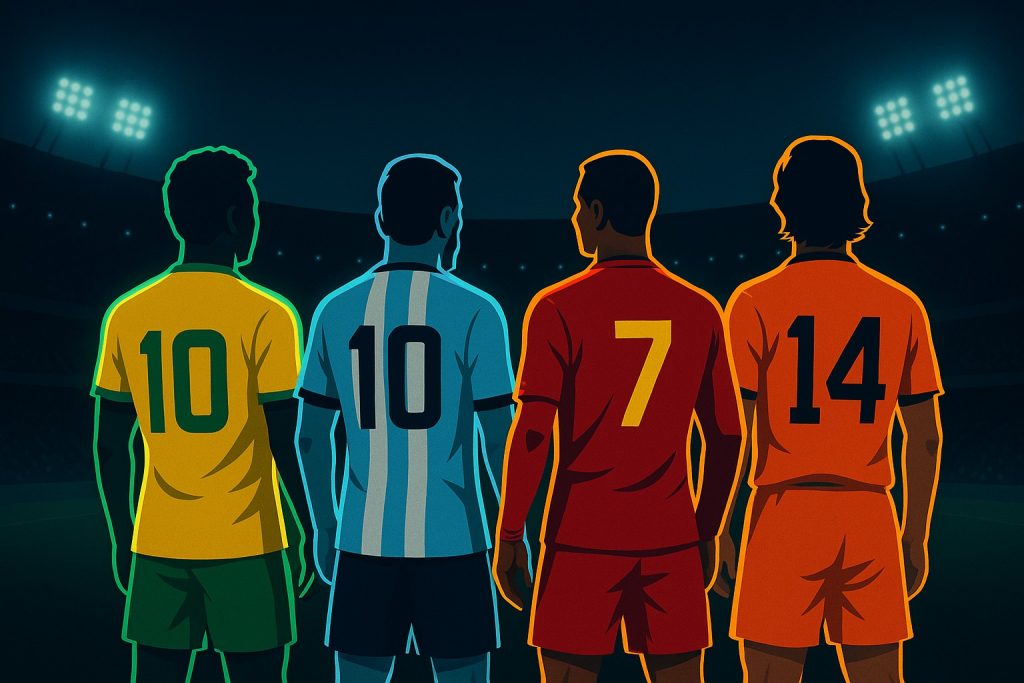
Who is the greatest football player of all time? Lionel Messi, Pelé, Diego Maradona and Cristiano Ronaldo defined different eras of the game, while the 2026 World Cup added another chapter to football history. This updated all-time ranking compares the greatest players ever based on trophies, peak dominance, longevity, individual quality, big-game impact and historical influence. It also examines how the 2026 World Cup affects the legacies of Messi and Ronaldo – and whether Kylian Mbappé and world champion Lamine Yamal could eventually challenge football’s established GOAT hierarchy.
This ranking was updated after the World Cup final on July 19, 2026. Spain defeated Argentina 1-0 to become world champions for the second time. Lionel Messi led Argentina to another World Cup final at the age of 39, won the Silver Ball and became the competition’s all-time leading scorer during the tournament. Kylian Mbappé won the Golden Boot, while Lamine Yamal became a world champion with Spain. Cristiano Ronaldo also made history by becoming the first player to score at six different World Cups.
Table of Contents
- Quick answer: Who is the greatest footballer ever?
- Key takeaways
- Methodology and ranking criteria
- Top 10 ranking table
- Top 10 best football players of all time
- GOAT comparison: Messi, Pelé, Maradona and Cristiano Ronaldo
- Best footballers by position
- Active stars and future GOAT candidates
- Honorable mentions
- FAQ
- Sources and data notes
Quick Answer: Who Is the Greatest Footballer Ever?
Lionel Messi is the greatest football player of all time in this updated ranking. The decisive argument is his extraordinary combination of playmaking, scoring, individual dominance, trophies and longevity. Winning the 2022 World Cup removed the biggest remaining criticism of his international career. At the 2026 World Cup, Messi reached another final at the age of 39 and became the tournament’s all-time leading scorer. Pelé remains the greatest World Cup pioneer, Diego Maradona perhaps the most mythical individual force and Cristiano Ronaldo the defining goalscorer of the modern era.
Key Takeaways
- No. 1: Lionel Messi leads this ranking through his combination of World Cup success, eight Ballon d’Or awards, historic scoring, playmaking and extraordinary longevity.
- World Cup 2026: Messi reached another final at the age of 39 and became the competition’s all-time leading scorer. Argentina lost the final 1-0 to Spain.
- Pelé remains a legitimate GOAT candidate because of his three World Cup titles, global influence and complete attacking skill set.
- Diego Maradona represents one of football’s greatest individual peaks, especially through the 1986 World Cup and his Napoli years.
- Cristiano Ronaldo remains the benchmark for scoring volume, Champions League success and longevity. In 2026, he became the first player to score at six different World Cups.
- Kylian Mbappé moved closer to the extended all-time elite after winning the Golden Boot at the 2026 World Cup.
- Lamine Yamal is no longer simply a future prospect after becoming a world champion with Spain, but an all-time Top 10 ranking still requires many years of sustained excellence.
- This ranking remains era-sensitive: trophies and statistics matter, but they are evaluated alongside peak level, playing style, historical context and long-term influence.
Methodology: How This All-Time Ranking Works
No ranking of the greatest footballers ever can be completely objective. Football has changed dramatically across generations: rules, tactics, pitches, athletic preparation, sports science, media pressure and competition formats differ significantly between the eras.
This ranking therefore looks beyond goals and trophies. It considers how dominant a player was in his own era, how strongly he influenced the biggest matches, how long he remained at world-class level and whether his style changed football beyond his own career.
Ranking criteria
Comparing Pelé in 1970, Maradona in 1986, Messi in 2012 and Cristiano Ronaldo in 2017 without historical context would be unfair. Earlier generations played on poorer pitches, faced more physical challenges and had no access to modern sports science. Today’s stars compete in tactically compressed, athletically intense and globally scrutinized football environments.
A serious all-time ranking should not ask only: “Who scored the most goals?” It must also ask: Who was most dominant at his peak? Who decided the biggest matches? Who changed football? And who remained among the world’s best for an exceptional period of time?
Top 10 Best Football Players of All Time: Ranking Table
| Rank | Player | Country | Main argument | Iconic peak |
|---|---|---|---|---|
| 1 | Lionel Messi | Argentina | Most complete combination of scoring, playmaking, trophies and longevity | 2009–2012, World Cup 2022, World Cup 2026 |
| 2 | Pelé | Brazil | Three World Cup titles, global icon and complete attacking player | World Cups 1958–1970 |
| 3 | Diego Maradona | Argentina | Extraordinary individual impact at the 1986 World Cup and Napoli | 1984–1990 |
| 4 | Cristiano Ronaldo | Portugal | Scoring records, Champions League dominance and historic longevity | 2013–2018 |
| 5 | Johan Cruyff | Netherlands | Tactical revolutionary and symbol of Total Football | 1971–1974 |
| 6 | Alfredo Di Stéfano | Argentina / Spain | Engine of Real Madrid’s first European dynasty | 1956–1960 |
| 7 | Franz Beckenbauer | Germany | Redefined the libero role and won the World Cup as player and coach | 1972–1976 |
| 8 | Zinedine Zidane | France | Big-game control, technique and major-tournament impact | 1998–2002 |
| 9 | Ronaldo Nazário | Brazil | Most explosive striker of his generation despite major injuries | 1996–1998, World Cup 2002 |
| 10 | Michel Platini | France | Three consecutive Ballon d’Or awards and Euro 1984 dominance | 1983–1985 |
The 10 Greatest Footballers of All Time
The following list combines measurable performance with historical significance. It is deliberately not a pure statistics ranking, but an attempt to compare players who dominated very different football eras.
1Lionel Messi
Position: False nine / right-sided playmaker / No. 10
Career: 2004–present (Barcelona, Paris Saint-Germain, Inter Miami)
Iconic peak: Barcelona 2009–2012, Copa América 2021 and 2024, World Cup 2022 and World Cup 2026
| Category | Value / significance |
|---|---|
| FIFA World Cup | Winner in 2022 |
| World Cup 2026 | Finalist, Silver Ball, all-time World Cup leading scorer |
| Copa América | 2021, 2024 |
| Ballon d’Or | 8 |
| UEFA Champions League | 4 |
| Core profile | Dribbling, passing, finishing, set pieces and game control |
Playing style: Messi combines several attacking roles at a historically elite level. He is a dribbler, playmaker, goalscorer, set-piece specialist and tempo controller at the same time. His greatest strength is not limited to individual moments of brilliance; it is his ability to manipulate space, pace and decision-making throughout an entire match.
Legacy: Winning the 2022 World Cup removed the biggest remaining criticism of his career. The 2026 tournament strengthened his longevity case even further: at 39, Messi led Argentina to another final, won the Silver Ball and extended his legacy by becoming the World Cup’s all-time leading scorer. Losing the final to Spain does not alter his No. 1 position in this ranking.
2Pelé
Position: Forward / second striker
Career: 1956–1977 (Santos, New York Cosmos)
Iconic peak: World Cups 1958–1970
| Competition | Achievement | Years |
|---|---|---|
| FIFA World Cup | 3 titles | 1958, 1962, 1970 |
| Copa Libertadores | 2 titles | 1962, 1963 |
| Intercontinental Cup | 2 titles | 1962, 1963 |
| Career goals | Varies by counting method | Official and unofficial matches should be separated |
Playing style: Pelé was far more than a penalty-box striker. He could finish, combine, dribble, head the ball and operate as a creative attacking force. For his era, that level of completeness was extraordinary.
Legacy: Pelé became football’s first truly global superstar and remains the only player to have won three World Cups. That achievement gives him an argument no other GOAT candidate can fully replicate.
3Diego Maradona
Position: Attacking midfielder / free No. 10
Career: 1976–1997 (Argentinos Juniors, Boca Juniors, Barcelona, Napoli, Sevilla)
Iconic peak: World Cup 1986, Napoli 1987–1990
| Competition | Achievement | Years |
|---|---|---|
| FIFA World Cup | Winner | 1986 |
| UEFA Cup | Winner | 1989 |
| Serie A | 2 titles | 1986/87, 1989/90 |
| Iconic moment | Goal of the Century | 1986 vs England |
Playing style: Maradona created chaos in the best possible sense. His low center of gravity, left foot, balance and explosive changes of direction allowed him to solve situations that appeared tactically impossible.
Legacy: The 1986 World Cup triumph and his Serie A titles with Napoli give Maradona a unique place in football history. Few players better represent the idea of one genius transforming the ceiling of an entire team.
4Cristiano Ronaldo
Position: Winger / striker
Career: 2002–present (Sporting CP, Manchester United, Real Madrid, Juventus, Al-Nassr)
Iconic peak: Real Madrid 2013–2018, Portugal Euro 2016
| Category | Value / significance |
|---|---|
| UEFA Champions League | 5 titles |
| Ballon d’Or | 5 |
| European Championship | 2016 |
| UEFA Nations League | 2019, 2025 |
| Champions League goals | 140 |
| World Cup record 2026 | First player to score at six different World Cups |
Playing style: Ronaldo evolved from an explosive dribbling winger into one of the most efficient finishers in football history. His career is an extraordinary case study in adaptation: speed, athleticism, heading, movement, finishing and penalty-box timing were repeatedly adjusted to suit each stage of his career.
Legacy: Cristiano Ronaldo is one of football’s greatest goalscorers and remains the all-time leading scorer in the UEFA Champions League. He added another historic milestone in 2026 by becoming the first player to score at six different World Cups. The absence of a World Cup title remains a disadvantage compared with Messi and Pelé, but it does not diminish his extraordinary longevity and record-breaking international career.
5Johan Cruyff
Position: False nine / playmaker / free attacker
Career: 1964–1984 (Ajax, Barcelona, Feyenoord)
Iconic peak: Ajax 1971–1973, World Cup 1974
| Category | Achievement / significance |
|---|---|
| Ballon d’Or | 3 |
| European Cup | 3 consecutive titles with Ajax |
| Legacy | Total Football, positional rotation and lasting influence on Ajax and Barcelona |
Playing style: Cruyff was not merely a brilliant player; he was a tactical idea in motion. He interpreted space, pulled defenders out of position and often appeared to think like a coach while still playing the game.
Legacy: Few players have influenced football so deeply beyond their own playing careers. Cruyff’s ideas continue to shape Ajax, Barcelona and many modern possession-based systems.
6Alfredo Di Stéfano
Position: Complete forward / attacking organizer
Career: 1945–1966 (River Plate, Millonarios, Real Madrid)
Iconic peak: Real Madrid 1956–1960
| Competition | Achievement / significance |
|---|---|
| European Cup | 5 consecutive titles |
| Ballon d’Or | 2 |
| Role | Complete attacker, creator, organizer and scorer |
Playing style: Di Stéfano was an early prototype of the total attacking footballer. He dropped into midfield, organized attacks, worked without the ball, distributed passes and still arrived in scoring positions.
Legacy: Without Di Stéfano, Real Madrid may never have become Europe’s first dominant superpower so quickly. His importance to the club’s identity and history is difficult to overstate.
7Franz Beckenbauer
Position: Libero / ball-playing defender
Career: 1964–1983 (Bayern Munich, New York Cosmos)
Iconic peak: Euro 1972, World Cup 1974, Bayern Munich 1974–1976
| Competition | Achievement |
|---|---|
| FIFA World Cup | 1974 as player, 1990 as coach |
| European Championship | 1972 |
| European Cup | 3 consecutive titles |
| Ballon d’Or | 2 |
Playing style: Beckenbauer transformed the libero from a defensive spare man into a playmaking position. He defended, initiated attacks, carried the ball into midfield and created superiority from deep areas.
Legacy: His combination of elegance, leadership, tactical innovation and major trophies makes him the greatest German footballer in this ranking.
8Zinedine Zidane
Position: Attacking midfielder / classic No. 10
Career: 1989–2006 (Cannes, Bordeaux, Juventus, Real Madrid)
Iconic peak: World Cup 1998, Euro 2000, Champions League final 2002
| Category | Value |
|---|---|
| FIFA World Cup | 1998 |
| European Championship | 2000 |
| FIFA World Player of the Year | 3 |
| Champions League | 2002 as player |
Playing style: Zidane controlled major matches through first touch, body orientation, technique and timing. He was not a volume scorer, but his influence often became most visible when the pressure was highest.
Legacy: The 1998 World Cup final, Euro 2000 and his volley in the 2002 Champions League final remain among the most iconic moments of modern football history.
9Ronaldo Nazário
Position: Striker
Career: 1993–2011 (Cruzeiro, PSV, Barcelona, Inter, Real Madrid, Milan, Corinthians)
Iconic peak: Barcelona 1996/97, Inter 1997/98, World Cup 2002
| Category | Value |
|---|---|
| FIFA World Cup | 1994, 2002 |
| Ballon d’Or | 2 |
| FIFA World Player of the Year | 3 |
| Career limitation | Several major knee injuries |
Ronaldo lost several potential peak years to serious knee injuries. That makes his all-time ranking unusually difficult: his best level was historic, but his longevity at maximum level was lower than Messi’s or Cristiano Ronaldo’s.
Playing style: Ronaldo represented explosiveness in its purest form. Acceleration, close control, changes of direction and finishing combined into a striker profile that attacked defenders directly and frequently overwhelmed them.
Legacy: “El Fenómeno” shaped the image of the modern explosive striker. Without his injury history, an even higher place in all-time rankings would be entirely realistic.
10Michel Platini
Position: Attacking midfielder / playmaker
Career: 1972–1987 (Nancy, Saint-Étienne, Juventus)
Iconic peak: Euro 1984, Juventus 1983–1985
| Category | Value |
|---|---|
| Ballon d’Or | 3 consecutive wins (1983, 1984, 1985) |
| European Championship | 1984 |
| Euro 1984 | 9 goals in 5 matches |
| Profile | Playmaker, set pieces and goals from midfield |
Playing style: Platini was the rare playmaker who could produce like a goalscorer. His set pieces, late runs and finishing ability made him Europe’s dominant attacking midfielder in the mid-1980s.
Legacy: Three consecutive Ballon d’Or awards and his extraordinary Euro 1984 tournament secure his position in the extended GOAT debate.
GOAT Comparison: Messi vs Pelé vs Maradona vs Cristiano Ronaldo
The four strongest GOAT cases are built on different arguments. Messi represents completeness and longevity, Pelé has unmatched World Cup title history, Maradona represents an extraordinary individual peak and Cristiano Ronaldo has historic scoring volume and longevity.
| Category | Messi | Pelé | Maradona | Cristiano Ronaldo |
|---|---|---|---|---|
| World Cup titles | 1 | 3 | 1 | 0 |
| Additional World Cup legacy | Finalist in 2014 and 2026; all-time World Cup leading scorer | Only player with 3 World Cup titles | Finalist in 1990 | First player to score at 6 different World Cups |
| Continental national-team titles | Copa América 2021 and 2024 | – | – | Euro 2016, Nations League 2019 and 2025 |
| Champions League / European Cup | 4 | – | – | 5 |
| Ballon d’Or | 8 | Not regularly eligible during his playing career | Not regularly eligible during his playing career | 5 |
| Main argument | Completeness and longevity | World Cup success and global influence | Peak and individual impact | Scoring volume and longevity |
| Main counterargument | International breakthrough came relatively late | Difficult comparison with European club football | Less sustained elite longevity | No World Cup title and less playmaking influence |
Analysis: Why Messi remains No. 1 after the 2026 World Cup
Messi’s position at No. 1 does not depend on one trophy. The decisive factor is the combination of historic scoring, elite playmaking, eight Ballon d’Or awards, four Champions League titles, continental success with Argentina and the 2022 World Cup.
The 2026 World Cup strengthens his longevity case in particular. At the age of 39, Messi remained a central figure for a World Cup finalist, won the Silver Ball and became the competition’s all-time leading scorer. Losing the final to Spain changes little in the broader assessment of a career already built on more than two decades of elite performance.
Messi has the most complete overall profile in this ranking. Pelé owns the strongest World Cup title argument. Maradona represents one of football’s most extraordinary peaks and myths. Cristiano Ronaldo remains the defining goalscorer and one of the most durable elite players in football history.
Best Footballers by Position
Overall all-time rankings naturally favor attacking players. A position-by-position view provides a more balanced perspective on football history.
| Position | Top candidates | Assessment |
|---|---|---|
| Goalkeeper | Lev Yashin, Gianluigi Buffon, Manuel Neuer, Iker Casillas | Yashin remains historically unique, while Neuer transformed the modern interpretation of the goalkeeper role. |
| Defender | Franz Beckenbauer, Paolo Maldini, Franco Baresi, Sergio Ramos | Beckenbauer ranks highest because of his tactical innovation, build-up influence and trophy record. |
| Midfielder | Zinedine Zidane, Michel Platini, Xavi, Andrés Iniesta, Lothar Matthäus | In midfield, control and decision-making often matter more than raw scoring statistics. |
| Winger / creative attacker | Lionel Messi, Cristiano Ronaldo, George Best, Ronaldinho, Garrincha | The profiles range from pure dribbling creativity to elite scoring from wide areas. |
| Center forward | Pelé, Ronaldo Nazário, Gerd Müller, Ferenc Puskás, Erling Haaland | Goals are essential, but peak level, trophies and big-game influence must also be considered. |
Active Stars: Who Could Still Reach the All-Time Top 10?
Kylian Mbappé, Erling Haaland and Lamine Yamal are at very different stages of their careers. Mbappé already belongs in the extended historical elite because of his extraordinary World Cup record. Haaland has produced exceptional scoring numbers in club football. Yamal has already won major international titles at an extremely young age. For all three, however, sustained dominance over many seasons remains the decisive requirement for a genuine all-time Top 10 case.
Kylian Mbappé: Already on the Road to the All-Time Elite?
Mbappé’s historical standing changed again at the 2026 World Cup. He was already a world champion in 2018 and scored a hat-trick in the 2022 final against Argentina. In 2026, he added the Golden Boot to an already exceptional World Cup résumé.
That means Mbappé is no longer merely a future prospect for the GOAT conversation. His performances on football’s biggest international stage already place him in rare historical company. To break into an extremely exclusive all-time Top 10, however, he still needs sustained world-class performance and a complete club and individual legacy across the full span of his career.
Among currently active players outside Messi and Cristiano Ronaldo, Mbappé has one of the strongest potential paths toward an eventual all-time Top 10 ranking. His World Cup résumé is already a major differentiator.
Erling Haaland: Historic Scoring as His Main Argument
Haaland’s strongest case is his extraordinary efficiency as a goalscorer. Physical power, movement, penalty-box intelligence and finishing ability make him one of the most dangerous center forwards of his generation.
Even historic scoring numbers alone are not enough for an all-time Top 10 ranking. Haaland still needs sustained dominance and additional defining moments in the biggest club and international competitions. His career retains enormous historical potential, but it remains too early for a final assessment.
Lamine Yamal: A World Champion at 19, but Still at the Beginning
Lamine Yamal’s historical trajectory has changed dramatically since the earlier version of this ranking. After winning Euro 2024, he became a world champion with Spain in 2026 and has already been part of major international success at an exceptionally young age.
It would still be far too early to compare Yamal directly with Messi, Pelé or Maradona. All-time greatness is not defined only by a spectacular start. It requires a decade or more of sustained excellence, individual dominance and repeated influence on football’s biggest matches.
Yamal’s starting position is extraordinary. Winning the 2026 World Cup makes him a serious long-term name to monitor in future all-time debates – but not yet a Top 10 player in football history.
Honorable Mentions: Who Just Misses the Top 10?
Any list of only ten footballers will inevitably leave extraordinary legends outside. Depending on the criteria and weighting, the following names all have arguments for a higher position:
George Best
Ronaldinho
Ferenc Puskás
Gerd Müller
Marco van Basten
Paolo Maldini
Franco Baresi
Xavi
Andrés Iniesta
Garrincha
Lev Yashin
Why George Best Is Not in the Top 10
George Best remains one of football’s greatest natural talents. His peak quality, dribbling and cultural influence are unquestioned. Compared with players such as Platini, Di Stéfano or Beckenbauer, however, he lacks the same long-term trophy dominance and impact at major international tournaments.
Why Maldini, Xavi and Iniesta Also Have Top 10 Arguments
Paolo Maldini represents defensive excellence across an extraordinary period of time. Xavi and Andrés Iniesta were central figures in one of the most dominant club and international eras in football history. Their absence from this Top 10 also demonstrates how mixed all-time rankings tend to favor attacking individualists.
FAQ: Top 10 Best Football Players of All Time
Who is the best football player of all time?
Lionel Messi ranks as the greatest football player of all time in this ranking. The decisive factors are his combination of scoring and playmaking, extraordinary longevity, eight Ballon d’Or awards, the 2022 World Cup and his success at both club and international level.
Did the 2026 World Cup change Messi’s place in the GOAT ranking?
Messi remains No. 1 in this ranking. Argentina lost the 2026 World Cup final to Spain, but Messi reached another final at the age of 39, won the Silver Ball and became the competition’s all-time leading scorer during the tournament. The 2026 World Cup therefore strengthens his longevity argument in particular.
Is Messi better than Cristiano Ronaldo?
Messi ranks ahead of Cristiano Ronaldo here because he combines historic scoring with elite playmaking and creative control. Ronaldo has especially strong arguments in scoring volume, Champions League records, athleticism and longevity.
Why is Pelé not ranked No. 1?
Pelé remains a legitimate GOAT candidate because of his three World Cup titles and global importance. Messi ranks slightly higher here because his overall profile of playmaking, scoring, individual dominance and longevity is considered more complete.
Who is the greatest German footballer of all time?
Franz Beckenbauer is the greatest German footballer of all time in this ranking. His trophies, interpretation of the libero role, influence on build-up play and success as both player and coach make him historically unique.
Can Kylian Mbappé reach the all-time Top 10?
Yes. With a World Cup title in 2018, a hat-trick in the 2022 final and the Golden Boot at the 2026 World Cup, Mbappé already has an extraordinary World Cup résumé. To enter the historical Top 10, however, he still needs sustained world-class performance and a complete elite-level legacy across many more seasons.
Can Lamine Yamal become a GOAT candidate after winning the 2026 World Cup?
Yamal’s starting position is extraordinary because he has already achieved major international success at a very young age. It is still far too early for a serious GOAT assessment. The decisive question is whether he can remain among the absolute elite for a decade or more and repeatedly shape football’s biggest matches.
Sources and Data Notes
All-time rankings combine verifiable facts with subjective historical weighting. Major tournament results, awards and records have been updated using official sources where possible. Career statistics and records for active players can continue to change.
- FIFA: Spain 1-0 Argentina – World Cup 2026 final report
- FIFA: World Cup 2026 award winners
- FIFA: Lionel Messi becomes the World Cup’s all-time leading scorer
- UEFA: Portugal at the 2026 World Cup and Cristiano Ronaldo’s records
- UEFA: Cristiano Ronaldo’s UEFA records
- UEFA: Champions League all-time top scorers
- Inter Miami CF: Lionel Messi wins eighth Ballon d’Or
Content updated: July 20, 2026. Career and record information for Lionel Messi, Cristiano Ronaldo, Kylian Mbappé, Erling Haaland and Lamine Yamal should be reviewed again during future updates.
Ähnliche Beiträge / Similar Posts
 Football Clubs in London: Complete Guide to Teams, Stadiums, Map and Rivalries
 The Data Revolution in the Premier League: How Tactical Analysts Are Shaping Modern Football
 VAR in Europe’s Big Five Leagues: Latest Data, Errors & Trends
 How the Football Transfer Market Really Works (Complete Guide)
 PSG vs Arsenal 2026 Final: Tactical Analysis & Key Stats
 The Biggest Football Scandals: 10 Cases That Shook the Game