
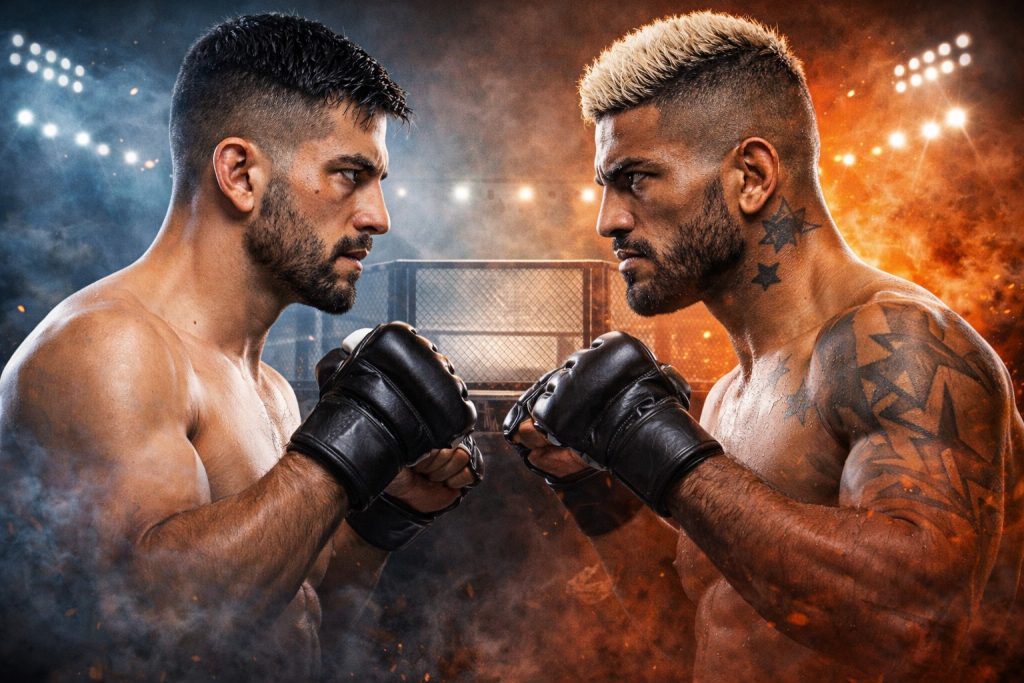
Not every Fight Night feels like a fork in the road — but this one does. Mario Bautista meets Vinicius Oliveira in a main event that isn’t about a belt, but can still change the conversation in the UFC’s most unforgiving weight class. If you want the stakes, the story, and the “what should I watch for?” moments — you’re in the right place.
Table of Contents
Jump links1. The Hook: Why Bautista vs. Oliveira matters right now
There are Fight Nights that feel like background noise — and then there are Fight Nights that feel like the matchmakers are quietly daring you to pay attention. Bautista vs. Oliveira lives in that second category. No title on the line, no stadium spectacle, just the kind of main event that can shove a fighter into relevance or leave him staring at the ceiling wondering how fast the division moved without him.
The setting: small room, big consequences
The APEX doesn’t give you a crowd to hide in. You hear corners, you hear impact, you hear momentum shift in real time. That’s why these cards can feel brutally honest: when someone breaks, you can almost hear it. And when someone rises, it looks inevitable — even if it wasn’t thirty seconds earlier.
The stakes: bantamweight doesn’t wait for anyone
Bantamweight is the UFC’s pressure cooker. Everyone can fight. Everyone can scramble. Everyone can sprint for fifteen minutes. That means “one big win” isn’t a vibe — it’s currency. This main event is a chance to cash in, to turn a name into a storyline, and a storyline into better matchups.
For Mario Bautista, this is the kind of opportunity you earn the hard way: staying busy, winning the ugly minutes, proving you can handle the pace without needing perfect conditions. He’s the guy who makes opponents work for everything — and when that pressure stacks up, people start making decisions they regret.
For Vinicius Oliveira, this is the jump. The spotlight doesn’t get much brighter than a five-round main event, and the message is simple: win here and you don’t just win a fight — you win a different future. The kind where you’re no longer “dangerous,” you’re scheduled as a problem.
What fans should feel watching this one
- Tension early: this matchup has “first big swing matters” energy.
- Momentum in layers: the story won’t be one moment — it’ll be a stack of small wins.
- A real turning point: someone leaves the APEX with a new ceiling, someone leaves with new questions.
“Fight Nights don’t always crown champions — sometimes they create contenders.” — and this main event has that exact feel
Next, we zoom out and set the table: what the APEX changes, why Fight Night main events have their own kind of pressure, and how this specific setting can shape the way Bautista and Oliveira solve problems under the lights.
2. The Setting: APEX Energy and Fight Night Stakes
Every UFC venue shapes fights, but few do it as directly as the APEX. Without a roaring crowd or visual distractions, the focus tightens. Pace, pressure, and composure become impossible to fake. For main events like Bautista vs. Oliveira, this environment strips the fight down to its essentials: who adapts faster, who handles fatigue better, and who stays sharp when there’s nowhere to hide.
2.1 What the APEX changes inside the cage
The cage at the APEX feels smaller, even if the dimensions say otherwise. Corners are louder, instructions clearer, and momentum swings are immediate. Fighters can’t rely on adrenaline from a crowd surge; they have to manufacture their own energy. That often favors athletes who fight with structure and discipline rather than emotion.
Five rounds in this setting can feel longer than five rounds anywhere else. Every clinch, every scramble, every reset is heard and felt. Mistakes don’t fade into noise — they echo.
2.2 Fight Night pressure: different from pay-per-view
Fight Nights don’t come with the spectacle of pay-per-views, but the pressure is often sharper. There’s less room for error and fewer safety nets. These cards are where fighters are evaluated closely — by matchmakers, by coaches, and by the rest of the division watching at home.
A main event win here doesn’t just look good on paper; it signals reliability. It tells the UFC that a fighter can headline, carry five rounds, and deliver under quiet but unforgiving conditions.
Why this matters for Bautista vs. Oliveira
- Endurance is tested honestly: no crowd energy, no shortcuts.
- Game plans are exposed: adjustments must be real, not reactive.
- Mental lapses are punished: the APEX magnifies hesitation.
This setting doesn’t decide the winner — but it narrows the path. To understand who benefits most, we need to look closer at the fighters themselves, starting with the man who has built his reputation on pressure and consistency.
3. Main Event Breakdown: Bautista vs. Oliveira
Five rounds change the way fights breathe. What looks manageable over fifteen minutes starts to feel heavy over twenty-five. In the APEX, that effect is amplified. Bautista vs. Oliveira isn’t just a test of skill — it’s a test of patience, decision-making, and how well each fighter understands when to push and when to survive.
3.1 Mario Bautista: pressure, pace, and earned momentum
Bautista’s game is built on accumulation. He doesn’t rely on one moment to win fights; he builds advantages layer by layer. Forward pressure, steady output, and a willingness to make opponents work in uncomfortable positions are his calling cards.
Over five rounds, that style becomes a tax. Even when Bautista isn’t dominating exchanges, he’s asking questions constantly. Can you keep circling? Can you keep defending takedowns? Can you keep making the right read after ten minutes of friction? Those questions pile up.
3.2 Vinicius Oliveira: danger, timing, and breakout potential
Oliveira brings a different kind of threat. He’s sharper early, more explosive in bursts, and more willing to turn small openings into big moments. Where Bautista leans on volume, Oliveira leans on timing.
The question isn’t whether Oliveira can hurt Bautista — it’s whether he can do it consistently enough to change the rhythm of a five-round fight. If he forces Bautista to reset repeatedly, this becomes a very different night.
3.3 The key questions that decide this fight
- Who controls the pace? If Bautista dictates tempo, the fight tilts slowly in his favor.
- Can Oliveira force respect early? Big moments change how pressure is applied — and defended.
- What happens after round three? This is where Fight Night main events quietly separate contenders from hopefuls.
On paper, this matchup looks balanced. In practice, it’s about whose strengths show up more often — and more reliably — over twenty-five minutes. To fully appreciate how this main event fits into the night, we need to look beyond the headliner and into the rest of the card.
4. The Rest of the Card: The Fights That Steal the Show
The headliner is the headline — but Fight Nights are remembered for the moments that hit you before you’re even settled on the couch. This card has a few matchups that carry real “don’t blink” energy: stylistic tension, career momentum, and that APEX reality where you can hear everything.
Spotlight Fights to Circle on Your Screen
Kyoji Horiguchi vs. Amir Albazi (Flyweight)
This is the kind of fight that instantly raises the technical level of a Fight Night. Horiguchi brings veteran poise and speed, Albazi brings urgency and the mindset of someone who believes he belongs in the upper tier. If this turns into a rhythm battle — who can win the minutes, not just the moments — it could be the hidden gem of the night.
Rizvan Kuniev vs. Jailton Almeida (Heavyweight)
Heavyweight doesn’t need many words: one clean moment can rewrite everything. The intrigue here is contrast — a newcomer trying to prove he belongs versus a known finisher trying to erase any doubts and get back on a fast track. In the APEX, where resets feel brutal and mistakes echo, this could swing hard and fast.
Alex Morono vs. Daniil Donchenko (Welterweight)
This is a classic Fight Night “experience vs. ambition” setup. Morono has seen every kind of chaos the UFC can offer. Donchenko has the hunger of someone trying to break into the conversation quickly. These are the matchups where momentum changes hands — or gets shut down loudly.
Nikolay Veretennikov vs. Jose Henrique Souza (Middleweight)
Middleweight is a division where one strong performance can change your trajectory overnight. This matchup has that “prove it” feel — the kind of fight where the winner doesn’t just get a hand raised, but earns the right to face a tougher name next.
Why these fights matter for the main event vibe
When the undercard delivers, the main event feels sharper. The pace rises, the urgency rises, and suddenly five rounds don’t feel like “extra time” — they feel like a final exam. If one of these matchups produces a fast finish or a wild swing, it changes the emotional temperature of the whole night.
Now that the card has faces and matchups, the next step is the fun part: how nights like this tend to unfold — where pressure builds, where mistakes happen, and what patterns fans can watch for without needing a coach’s clipboard.
5. How These Fights Tend to Play Out: A Fan-Friendly Tactical Guide
You don’t need a coach’s eye to understand how Fight Nights like this usually unfold. They follow patterns — not rigid scripts, but familiar rhythms. If you know where to look, you can feel a fight turning long before the scorecards ever matter.
The opening minutes: information before violence
Early in Fight Night bouts, especially at the APEX, fighters are reading more than attacking. Distance, reactions, clinch strength — all of it gets tested quietly. When someone explodes early, it’s usually because they saw something exploitable, not because they were reckless.
The middle stretch: pressure reveals truth
This is where Fight Nights separate fighters who can fight fast from fighters who can fight long. Pressure builds, corners get louder, and footwork starts to slip. If a fighter begins backing up in straight lines or clinching just to breathe, the tide is turning.
Five-round fights: where narratives actually change
In main events, the third and fourth rounds are the truth serum. Early success only matters if it holds up under fatigue. Fighters who keep making good decisions late — choosing when to exchange and when to stall — are the ones who earn real trust from matchmakers.
Common turning points fans can spot live
- Breathing changes: open mouth, slower resets.
- Footwork tells: circles become retreats.
- Clinch choices: control vs. survival.
- Corner urgency: instructions shift from advice to demands.
Why the APEX magnifies all of this
With no crowd to mask momentum shifts, everything feels sharper. When someone takes over, it’s obvious. When confidence drains, it’s audible. That transparency is why Fight Nights often feel more “real” than bigger shows.
By the time the main event reaches its later rounds, these patterns usually converge. Pressure meets fatigue, decision-making meets desperation. That’s where predictions stop being abstract — and paths to victory become clear.
6. Predictions: Win Paths, Chaos Paths, and What to Watch For
Predictions on a Fight Night aren’t about picking a winner and moving on. They’re about understanding how a fight is most likely to be won — and what needs to break for the less obvious outcome to happen. Bautista vs. Oliveira is a perfect example of that tension.
The Bautista win path: accumulation and control
Bautista’s clearest route is familiar: steady pressure, high work rate, and few mistakes. He doesn’t need to dominate every round — he needs to keep Oliveira reacting. If the fight stretches past the midpoint with Bautista still pushing forward, the odds quietly tilt in his favor.
Look for clinch time against the fence, grinding exchanges, and moments where Oliveira is forced to reset instead of counter. Those minutes don’t look dramatic, but they decide scorecards and break rhythm.
The Oliveira win path: disruption and damage
Oliveira’s path is sharper and more volatile. He needs moments that force Bautista to hesitate — clean counters, explosive entries, and visible damage that changes the pace of the fight. Early success matters more for him than for Bautista.
If Oliveira can win the respect battle in the first two rounds, he turns the main event into a much more dangerous, unpredictable affair. That’s where momentum swings fast — especially in the APEX.
The chaos path: when Fight Nights stop following logic
Fight Nights have a habit of ignoring tidy narratives. A slip, a scramble gone wrong, a moment of fatigue — and suddenly the expected script collapses. This matchup has just enough volatility that a late finish or sudden momentum flip wouldn’t feel shocking.
Signs the fight is swinging
- Bautista slowing: pressure pauses, clinches shorten.
- Oliveira fading: counters lose snap, exits get messy.
- Corner urgency: advice turns into demands.
Final lean (without pretending it’s certain)
Over five rounds, consistency usually beats volatility. That gives Bautista a slight edge if the fight stays structured. But Oliveira carries the kind of threat that can erase structure quickly. This is a main event where the first big moment might not decide the fight — but it will decide how dangerous the rest of the night becomes.
In other words: expect tension, expect swings, and don’t expect certainty. If you’re watching for moments rather than just outcomes, this is exactly the kind of Fight Night main event that delivers.
7. Watch Guide: Start Times, Pacing, and How to Follow the Night
Fight Nights reward timing. Knowing when to tune in — and how the evening usually unfolds — can make the difference between catching the key moments live or seeing them as highlights the next morning. Bautista vs. Oliveira is built as a slow burn that accelerates late.
Expected schedule (local & international viewers)
- Prelims: early evening local time
- Main card: late evening in the U.S.
- Main event walkouts: typically 2.5–3 hours after main card start
Exact start times can shift slightly depending on finishes earlier in the night. If you only plan to catch the headliner, tuning in a bit early usually pays off.
How Fight Nights usually pace themselves
Fight Night cards tend to start fast and tighten up as the stakes rise. Early bouts often feature aggressive openings and quick finishes. By the time the co-main arrives, fighters slow the tempo, conserving energy and sharpening decisions.
Best way to watch as a fan
- Tune in early: momentum from the undercard carries forward.
- Watch the corners: APEX audio adds context you don’t get elsewhere.
- Stay patient: main events often reward late-round focus.
Official broadcast reference
For the most up-to-date broadcast details and regional availability, the official UFC event page remains the most reliable reference. View official event information
Once you know the rhythm of the night, the viewing experience changes. Instead of chasing highlights, you start anticipating moments — and that’s when Fight Nights like this become genuinely memorable.
FAQ — UFC Fight Night: Bautista vs. Oliveira
When does UFC Fight Night: Bautista vs. Oliveira take place?
The event takes place on Saturday, February 7, 2026, at the UFC APEX in Las Vegas. As with most Fight Nights, the main event is expected late in the evening U.S. time.
Is Bautista vs. Oliveira a title fight?
No. This is a five-round main event, but no championship belt is on the line. The stakes are about ranking position, momentum, and future matchmaking in the bantamweight division.
Why is this main event important despite not being a title fight?
Fight Night main events often act as proving grounds. A convincing win over five rounds can elevate a fighter’s standing quickly, especially in a deep division like bantamweight where momentum matters.
What makes the UFC APEX different from arena events?
The APEX offers a smaller, quieter environment. Fighters can hear corners clearly, momentum shifts feel sharper, and pressure builds differently without a live crowd. Many fans consider APEX Fight Nights more raw and revealing.
What should fans watch for in a five-round Fight Night main event?
Pay attention to pacing, corner instructions, and body language. Late-round decision-making often reveals more than early aggression, especially in matchups built around pressure and endurance.
Is this event suitable for casual UFC fans?
Yes. Fight Nights are often ideal entry points: clear storylines, less spectacle, and fights that reward attention without requiring deep knowledge of rankings or history.
Ähnliche Beiträge / Similar Posts
 Craig Jones Invitational 2 Las Vegas 2025: Teams, Superfights, Tickets & Livestream
 UFC 320 Las Vegas Preview: Ankalaev vs Pereira Rematch & Key Storylines
 UFC 321: Aspinall vs. Gane — The Heavyweight Collision That Could Redefine the Division
 MMA for Beginners: The 10 Rules You Need to Know Before Fight Night
 UFC 323: Dvalishvili vs. Yan 2 – Full Preview, Fight Card & Title Fight Breakdown
 PFL Road to Dubai 2026: Fight Card Analysis, Matchups and Title Fight Breakdown