
Article Data Status
Tournament-week information checked on July 14, 2026.
The Open Championship 2026 at a Glance
- The 154th Open will be staged at Royal Birkdale in Southport, England.
- The four championship rounds are scheduled for July 16–19, 2026.
- The tournament field and the opening two rounds of tee times have been published.
- The analysis combines recent form, major results, links performance and advanced player metrics.
- Course management, approach quality, ball control and mistake avoidance will be central to the predictions.
- Historical results will be used to define the type of player most likely to succeed at Royal Birkdale.
- The Open Index will rank the leading contenders through a transparent weighted scoring model.
- Significant withdrawals, weather changes and tournament updates will be documented before the opening round.
The Open Championship 2026: Event Overview
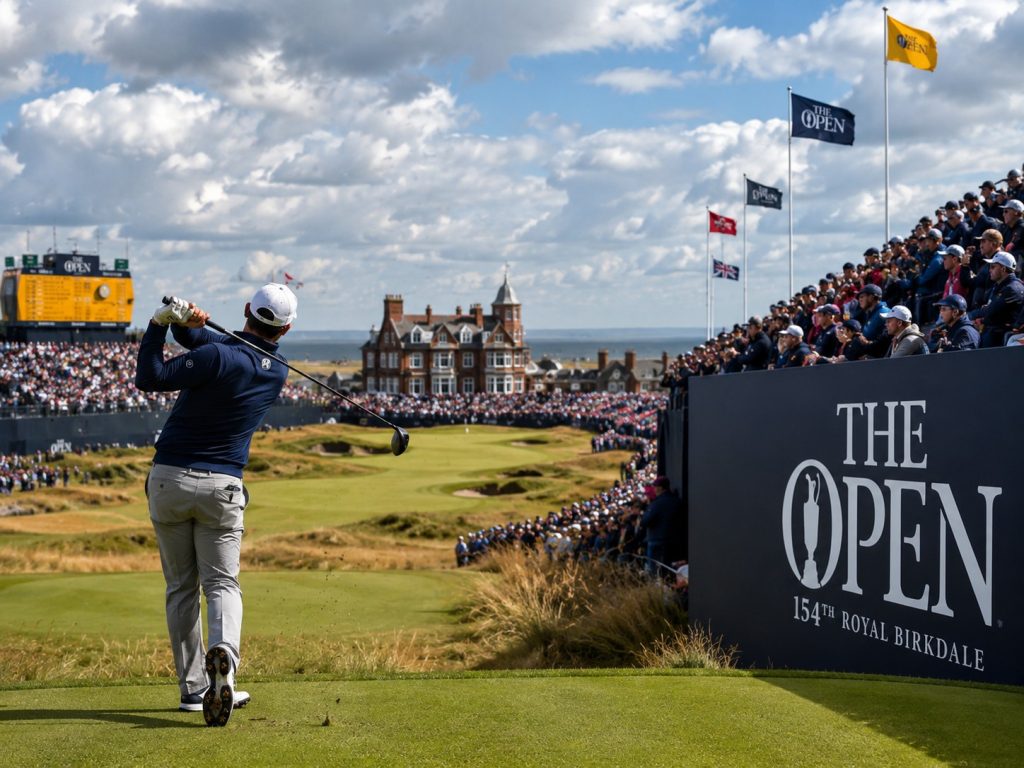
The Open Championship returns to Royal Birkdale in July 2026 for the 154th edition of golf’s original major. The Southport links will stage the championship for the 11th time, placing it among the most frequently used venues in Open history outside St Andrews.
Championship play begins on Thursday, July 16, and concludes on Sunday, July 19. The four rounds will determine who succeeds as Champion Golfer of the Year and lifts the Claret Jug at one of the most strategically demanding courses on the Open rota.
The 154th Open will be played at Royal Birkdale in Southport, England, from July 16 to July 19, 2026. The broader event week runs from July 12 to July 19 and includes four practice days before championship play.
Dates, Venue and Tournament Format
Royal Birkdale is located on the north-west coast of England in Southport, Merseyside. Its exposed links setting means that wind direction, firmness and changing coastal conditions can affect both scoring and shot selection throughout the week.
The championship is contested over four rounds of stroke play. Every player completes 18 holes on Thursday and Friday before the field is reduced for the weekend. The player with the lowest 72-hole total after Sunday’s final round becomes Champion Golfer of the Year.
| Official name | The 154th Open |
|---|---|
| Venue | Royal Birkdale Golf Club |
| Location | Southport, Merseyside, England |
| Event week | July 12–19, 2026 |
| Championship rounds | July 16–19, 2026 |
| Format | Four-round individual stroke play |
| Open appearances at Royal Birkdale | 11, including the 2026 championship |
| Defending Champion Golfer | Scottie Scheffler |
The wider event schedule began on Sunday, July 12. The four newly structured practice days lead into the opening round and include spectator activities, player preparation and a new Last-Chance Qualifier for the final available place in the championship.
- Sunday, July 12: Opening practice day and the beginning of event week.
- Monday, July 13: Practice and the 18-hole Last-Chance Qualifier.
- Tuesday, July 14: Main practice day and the Heroes Classic showcase.
- Wednesday, July 15: Final preparation before championship play.
- Thursday, July 16: First championship round.
- Friday, July 17: Second championship round.
- Saturday, July 18: Third championship round.
- Sunday, July 19: Final round and presentation of the Claret Jug.
Royal Birkdale’s Open Championship History
Royal Birkdale first hosted The Open in 1954, when Peter Thomson secured the first of his five Claret Jugs. The championship’s return in 2026 marks the venue’s 11th Open, reinforcing its status as one of the most established courses in the modern rotation.
The list of Royal Birkdale winners includes several of the sport’s most accomplished major champions. Peter Thomson won there twice, while Arnold Palmer, Lee Trevino, Johnny Miller, Tom Watson, Ian Baker-Finch, Mark O’Meara, Padraig Harrington and Jordan Spieth have also lifted the Claret Jug at the venue.
First Open at Royal Birkdale
Peter Thomson won in 1954, finishing one stroke ahead of Bobby Locke, Dai Rees and Syd Scott.
Most recent Open at the venue
Jordan Spieth won the 2017 championship after a dramatic final-round battle with Matt Kuchar.
Multiple Birkdale champion
Peter Thomson won at Royal Birkdale in both 1954 and 1965.
Venue significance
Outside St Andrews, no course had hosted The Open more frequently than Royal Birkdale before the 2026 championship.
Previous winners do not reveal one simple formula for success. Royal Birkdale has produced champions with different physical profiles and playing styles. The recurring traits are generally stronger: controlled ball flight, accurate approach play, patience and the ability to avoid damaging mistakes when the wind makes conservative decisions necessary.
Confirmed Field and Qualification
The Open uses a global qualification structure rather than relying on a single tour or ranking system. The field combines exempt players, leading performers from international tours, recent major champions, former Open winners who remain eligible and golfers who secure places through designated qualifying events.
Twenty players earned their places through Final Qualifying on June 30. Five positions were available at each of four venues: Burnham & Berrow, Dundonald Links, Royal Cinque Ports and West Lancashire. The final available place was then decided through the new Last-Chance Qualifier at Royal Birkdale on July 13.
Exemption categories
Major champions, eligible former Open winners, leading ranked players and high performers from recognized tours can qualify automatically.
Open Qualifying Series
Selected international tournaments allocate Open places to the highest-finishing eligible players who are not already exempt.
Final Qualifying
Twenty golfers advanced from four 36-hole qualifying events held on June 30.
Last-Chance Qualifier
A new 18-hole event at Royal Birkdale offered one final championship place on Monday of Open week.
The qualification system creates a broader field than a conventional tour event. Established stars compete alongside national champions, amateurs, regional qualifiers and players whose strongest recent results may have occurred outside the PGA Tour.
That diversity matters for a prediction model. Comparable strokes-gained data are not available for every competitor across every tour, meaning lower-profile qualifiers must sometimes be assessed using scoring performance, field strength, recent results and links experience rather than a complete set of standardized metrics.
Featured Groups and Opening Tee Times
The official draw for rounds one and two has been published. Defending Champion Golfer Scottie Scheffler will begin his title defence alongside Bryson DeChambeau and Tyrrell Hatton. Their group is scheduled to start at 9:58 a.m. on Thursday and 3:04 p.m. on Friday.
Another featured group brings together Shane Lowry, Aaron Rai and Brooks Koepka. They are scheduled for 2:53 p.m. on Thursday and 9:47 a.m. on Friday.
| Featured group | Thursday, July 16 | Friday, July 17 |
|---|---|---|
| Scottie Scheffler, Bryson DeChambeau and Tyrrell Hatton | 9:58 a.m. | 3:04 p.m. |
| Shane Lowry, Aaron Rai and Brooks Koepka | 2:53 p.m. | 9:47 a.m. |
Tee-time position is more relevant at The Open than at many other major championships because conditions can change sharply between the morning and afternoon waves. A shift in wind speed, rainfall or course firmness can create a meaningful scoring advantage for one side of the draw.
That potential wave effect should not be treated as a certainty before play begins. It will be incorporated into the final model only when the hour-by-hour weather forecast provides sufficient evidence that one group of starting times is likely to face materially easier conditions.
- The Open – The 154th Open at Royal Birkdale
- The Open – Event dates and key information
- The Open – Champion Golfers at Royal Birkdale
- The Open – Official championship field
- The Open – Qualification routes
- The Open – Final Qualifying results
- The Open – Round 1 and 2 featured groups
- The Open – Complete official tee times
Royal Birkdale Course Analysis
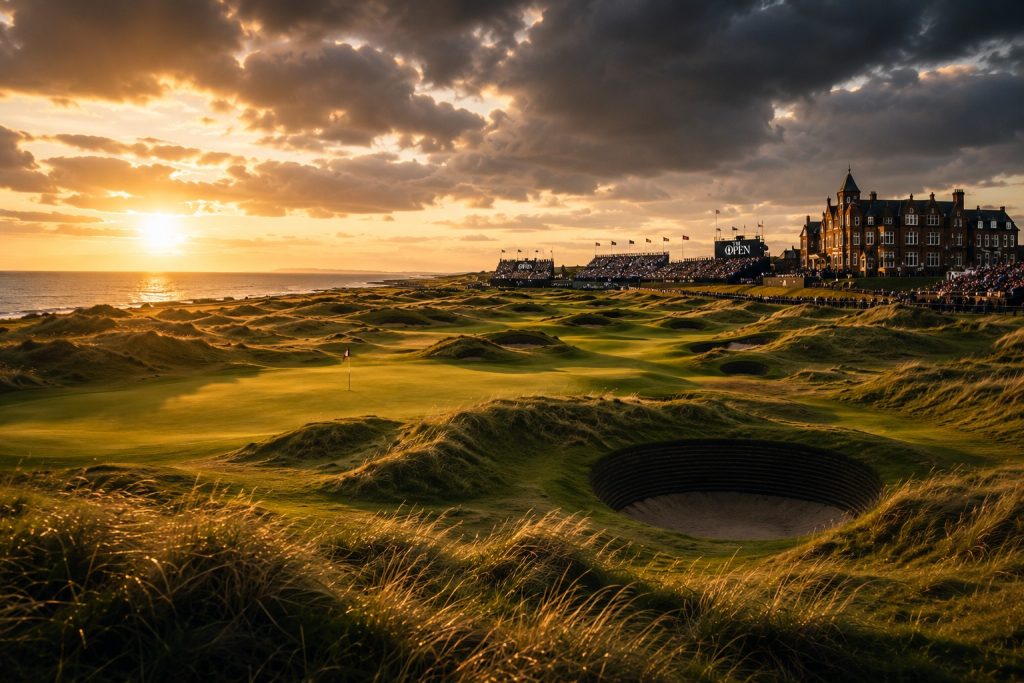
Royal Birkdale is not designed to reward uncontrolled aggression. Its fairways run through corridors of high dunes, while revetted bunkers, uneven lies and exposed coastal conditions repeatedly force players to choose between position and distance. The course presents most of its danger clearly, but knowing where the trouble is does not make avoiding it easy.
The 2026 layout also differs meaningfully from the course used for The Open in 2017. Redesigned holes, new green complexes and a more intimidating closing tee shot have strengthened the emphasis on accurate placement, distance control and disciplined decision-making.
The ideal Royal Birkdale contender combines accurate driving, strong approach play, controlled ball flight and reliable bogey avoidance. Power can create scoring opportunities on selected holes, but poor positioning is heavily punished by fairway bunkers, deep green-side traps and severe run-off areas.
Course Layout and Playing Characteristics
The championship course is set among natural sand dunes near the Irish Sea. Unlike links layouts where several holes are partially hidden by the terrain, Royal Birkdale is often described as a comparatively visible test: players can usually identify the correct line and see the principal hazards before choosing a shot.
That visibility contributes to the course’s reputation for being difficult but fair. The challenge is created less by surprise than by narrow landing zones, strategically positioned bunkers and greens that reject shots finishing on the wrong side.
The first six holes can place immediate pressure on a player’s score. The 447-yard opening hole demands an accurate tee shot between trouble on both sides, while the 514-yard sixth played as the most difficult hole during the 2017 championship. When it plays into the prevailing wind, the sixth can require two long, precisely positioned shots simply to create a realistic chance of making par.
The closing stretch creates a different type of pressure. The redesigned par-5 14th offers a possible scoring opportunity, but it is followed by a new 241-yard par-3, two strategically demanding par-4s and the reachable par-5 17th. The 508-yard 18th then asks contenders to negotiate a corridor of fairway bunkers before approaching the green beneath the clubhouse.
Key Holes and the Five Major Changes for 2026
Royal Birkdale completed a significant programme of course work ahead of The 154th Open. The most consequential championship changes affect the fifth, seventh, 14th, 15th and 18th holes. Together, they introduce new risk-reward decisions and make the final five holes substantially different from the finish faced by the field in 2017.
A completely redesigned risk-reward hole
The tee, fairway and green have all moved. Players can now see the target from the tee, but bunkers heavily guard the direct route. Laying up near 200 yards leaves a wedge, while attacking the green brings severe run-offs beyond and left of the putting surface into play.
The shortest hole has the smallest target
A raised and highly contoured green is protected by the deepest bunkers on the course. The famous donut-style bunker remains on the left. Although the shot is short, missing the correct section can turn a routine par attempt into a difficult recovery.
A long par-5 built around positioning
The former 15th now plays as the redesigned 14th. Bunkers influence both the drive and the second shot, while the small, undulating green features a significant run-off to the left. Players laying up must find a precise yardage rather than simply advancing the ball as far as possible.
A new long par-3 with a deceptive target
The new hole occupies the site of the former 14th. Its green is one of the largest on the course, but a narrow entrance makes it appear smaller from the tee. The surface slopes from front to back, making it difficult to stop the ball when the hole plays downwind.
A new tee angle transforms the finish
Moving the tee considerably left has straightened the final hole and brought a series of fairway bunkers into clearer view. Driver can shorten the approach, but finding sand may remove any realistic chance of reaching the green in regulation.
More decisions under pressure
The revised sequence places a potential birdie hole at the 14th immediately before the longest par-3 on the course. The 17th may offer another scoring chance, but the redesigned 18th can quickly punish a player who becomes overly aggressive.
| Hole | Length | Primary challenge | Likely strategic choice |
|---|---|---|---|
| 1st | Par 4, 447 yards | Tight opening drive with danger on both sides | Prioritize the fairway over maximum distance |
| 5th | Par 4, 321 yards | Bunkers and severe run-offs around a reachable green | Lay up for a wedge or attack when conditions are favourable |
| 6th | Par 4, 514 yards | Long approach into the prevailing wind | Select the correct tee-shot distance and protect par |
| 7th | Par 3, 151 yards | Small raised green and extremely deep bunkers | Play to the safest green section rather than chase every flag |
| 14th | Par 5, 602 yards | Layered bunkering and severe green-side run-offs | Choose a precise lay-up number unless the green is reachable |
| 15th | Par 3, 241 yards | Long tee shot to a green sloping away from the player | Control trajectory and avoid a short-sided miss |
| 17th | Par 5, 566 yards | Narrow two-tier green surrounded by bunkers | Attack after a well-positioned drive; otherwise lay up |
| 18th | Par 4, 508 yards | Fairway bunkers framed by the revised tee angle | Consider less than driver to preserve a clear approach |
Weather and Wind Analysis
Weather is normally one of the largest variables at The Open. At Royal Birkdale, the wind influences far more than club selection: it changes which fairway bunkers are reachable, whether short par-4s can be attacked and whether long par-3 greens can hold an incoming shot.
The current Met Office forecast points to an unusually settled start to the championship. Thursday is forecast to be sunny and warm, with a high near 26°C and a low probability of rain. Temperatures are expected to ease through the weekend, while Saturday currently carries the strongest forecast gusts of the four competitive days.
| Round | Forecast | High | Rain probability | Maximum forecast gust |
|---|---|---|---|---|
| Thursday | Sunny | 26°C | Below 5% | 19 mph |
| Friday | Sunny | 23°C | Below 5% | 19 mph |
| Saturday | Sunny intervals | 21°C | Below 5% | 21 mph |
| Sunday | Sunny | 21°C | Below 5% | 18 mph |
The projected wind is meaningful without currently appearing extreme. Gusts around 18–21 mph are sufficient to affect ball flight, especially on exposed tees and elevated approaches, but they would not necessarily create the survival conditions associated with the most severe Open weather.
A dry forecast may also reduce the advantage traditionally associated with pure carry distance. Extra rollout can help shorter hitters, while long drivers must judge whether the additional distance brings hazards into play. Players with strong trajectory control should benefit most when the wind and firm turf combine.
Which Statistics Matter Most at Royal Birkdale?
No single statistic can reliably predict an Open champion. Royal Birkdale requires a combination of long-game quality, mistake avoidance and adaptability that is difficult to capture with one season-long ranking.
Traditional PGA Tour strokes-gained data are also incomplete for parts of an international Open field. The prediction model must therefore combine standardized performance metrics with major results, links records and recent scoring relative to field strength.
- Approach play and proximity control Long par-4s and exposed par-3s place repeated pressure on iron play. Players must control both distance and trajectory rather than simply generate a high percentage of greens in regulation.
- Bogey avoidance Royal Birkdale offers birdie chances, but deep bunkers and severe run-offs can turn small misses into dropped shots. The ability to prevent doubles and limit three-putts is especially valuable.
- Driving accuracy and positional value Fairways found is useful but incomplete. The more important measure is whether a player consistently reaches the correct side of the fairway while avoiding bunkers that remove access to the green.
- Performance in windy conditions Wind-adjusted results, links history and demonstrated trajectory control help identify players whose games remain stable when conventional carry distances become unreliable.
- Short game from sand and tight lies The course demands different recovery techniques. Deep bunkers may require a purely defensive escape, while firm run-offs reward players capable of putting, bumping or pitching from closely mown turf.
- Long-iron and fairway-wood performance The 514-yard sixth, 502-yard 13th, 241-yard 15th and 508-yard 18th create an unusually high number of consequential shots from long range.
- Major-championship resilience Major results provide evidence of decision-making and scoring stability under difficult setups. They should complement, rather than replace, current performance data.
| Category | Why it matters | Potential limitation |
|---|---|---|
| Strokes gained: approach | Measures the quality of iron and wedge play relative to the field | Tour-to-tour data are not always directly comparable |
| Bogey avoidance | Captures scoring discipline when greens or fairways are missed | Can depend heavily on the difficulty of the courses played |
| Driving accuracy | Helps identify players likely to avoid costly fairway bunkers | Does not measure whether the correct fairway section was found |
| Links performance | Provides evidence of adaptability to wind, firm turf and unusual lies | Sample sizes can be small and weather conditions vary greatly |
| Scrambling | Reflects a player’s ability to save par after missing a green | Recovery difficulty differs across venues and grass types |
| Recent form | Gives greater weight to the player’s current level | A small number of tournaments can exaggerate short-term changes |
| Major performance | Adds evidence from the strongest fields and most demanding setups | Historical reputation can become overrated if current form is ignored |
The Open Index Prediction Model
The Open Index is a weighted scoring model created for this preview. It compares players across six categories that are relevant to current performance, major-championship quality and the specific demands of Royal Birkdale.
Every contender receives a score from 0 to 100. A higher number indicates a stronger overall statistical profile for this tournament, but it does not represent a literal percentage chance of winning.
The Open Index gives the greatest weight to current form and long-game performance. Links results, major history, mistake avoidance and championship-week conditions are then added to create a course-specific rating rather than a generic world ranking.
How the Open Index Works
World rankings are useful indicators of overall player strength, but they are not designed to predict performance at one specific course. The Open Index narrows the analysis by placing additional emphasis on skills that should translate effectively to Royal Birkdale.
The model combines results-based information with performance metrics. Recent tournaments receive more attention than older results, while links and major records are assessed over a longer period to reduce the influence of one unusually good or bad week.
- Collect the latest available performance data Recent results, field-adjusted performance, official rankings and strokes-gained statistics are gathered from the latest completed tournaments.
- Separate performance into comparable categories Metrics are grouped according to what they measure, preventing one closely related skill from being counted several times.
- Normalize results to a common scoring scale Each player is evaluated relative to the other serious contenders in the championship field rather than against an arbitrary fixed benchmark.
- Apply Royal Birkdale-specific weightings Long-game control, links evidence and mistake avoidance receive more value than categories with a weaker connection to the expected course demands.
- Add the championship-week adjustment Tee-time waves and forecast conditions are considered only when there is credible evidence that they could create a meaningful difference in playing difficulty.
- Convert the result to a 0–100 rating The final score is used to rank contenders and explain why one player’s profile may fit Royal Birkdale better than another’s.
Statistical Categories
Recent results and field-adjusted performance indicate whether a player is arriving with a competitive game.
Approach play, tee-to-green quality and positional driving measure the skills most frequently required before the ball reaches the green.
Results on links courses provide evidence of trajectory control, adaptability and comfort on firm coastal layouts.
Major results help assess performance against elite fields and under demanding competitive pressure.
Bogey avoidance, scrambling and scoring consistency reward players who limit the damage caused by missed fairways and greens.
A limited adjustment accounts for a potentially favourable or difficult tee-time wave without allowing uncertain forecasts to dominate the model.
| Category | Primary inputs | Evaluation period | Purpose |
|---|---|---|---|
| Current Form | Recent finishes, scoring performance and field-adjusted results | Primarily the latest eight to twelve starts | Measures the player’s current competitive level |
| Long Game | Strokes gained approach, tee to green, off the tee and greens-in-regulation indicators | Current season with recent performance emphasized | Identifies repeatable ball-striking quality |
| Links Performance | Open Championship results and relevant links-course events | Multi-season sample with recent editions prioritized | Measures adaptability to coastal conditions and firm turf |
| Major Performance | Finishes, cuts made and scoring in recent major championships | Recent three-year period with current-season majors emphasized | Assesses performance against the strongest fields |
| Mistake Avoidance | Bogey avoidance, scrambling, double-bogey frequency and scoring consistency where available | Current season and recent comparable events | Rewards players who prevent one poor hole from becoming costly |
| Draw and Weather | Official tee times and the latest hour-by-hour forecast | Championship week | Accounts for a possible difference between starting waves |
Why the Categories Receive Different Weights
Current form and long-game performance jointly account for half of the rating because they provide the strongest evidence of a player’s present ability to create scoring opportunities. A golfer with a strong historical Open record should not rank highly if the underlying game has deteriorated significantly.
Links performance receives 20% because Royal Birkdale requires skills that are not equally important at every tournament. Players must judge rollout, control trajectory and select shots from tight or uneven lies. Previous success in comparable conditions is therefore meaningful, although the sample size is usually smaller than a full season of tour data.
Major performance accounts for 15% and rewards evidence against elite fields without allowing reputation to outweigh current performance. Mistake avoidance receives 10%, reflecting the value of pars and the cost of bunker trouble or short-sided misses.
The weather and draw adjustment is capped at 5%. Forecasts can change, and an apparent wave advantage may disappear once play begins. The model therefore treats the draw as a secondary modifier rather than a core measure of player quality.
| Weighting | Maximum contribution | Model effect |
|---|---|---|
| Current Form | 25 points | Prevents historical reputation from outweighing present performance |
| Long Game | 25 points | Rewards sustainable tee-to-green performance |
| Links Performance | 20 points | Adds course-type relevance to the general performance data |
| Major Performance | 15 points | Recognizes proven performance in elite championship fields |
| Mistake Avoidance | 10 points | Rewards scoring stability and defensive skill |
| Draw and Weather | 5 points | Introduces a limited short-term course-conditions adjustment |
Limitations and Uncertainty
The Open Index is designed to organize evidence, not eliminate uncertainty. Golf outcomes remain highly variable, and even the strongest player in the model is more likely to lose than win in a full major-championship field.
Cross-tour data coverage
Standardized strokes-gained information is not equally available for every competitor. Alternative performance measures are required for some international players and qualifiers.
Links sample size
Most players contest only a limited number of true links events each year. One strong Open finish can therefore have an outsized effect on a small historical sample.
Changing course conditions
Royal Birkdale can play differently depending on firmness, wind direction and rainfall. Historical performance at the venue may not perfectly represent the conditions faced in 2026.
Short-term putting variance
A player can gain or lose several strokes on the greens during one round without a comparable change in underlying skill.
Weather-forecast uncertainty
Forecast timing and wind strength can change before play. The model limits the weather adjustment to prevent uncertain information from controlling the ranking.
Competitive randomness
Unusual lies, bunker positions, bounces and isolated mistakes can materially affect a 72-hole result even when the pre-tournament analysis is sound.
The Leading Favorites
Scottie Scheffler begins championship week as the strongest overall contender, but Royal Birkdale does not produce a one-player race on paper. Rory McIlroy, Matt Fitzpatrick and Tommy Fleetwood all combine high-level current performance with skills that should translate well to a firm, strategically demanding links course.
The leading group also includes Jon Rahm, Cameron Young, Aaron Rai and U.S. Open champion Wyndham Clark. Each has a credible route to the Claret Jug, although the balance between current form, links evidence and course fit differs significantly from player to player.
Scottie Scheffler is the model’s number-one contender because he leads the principal global rankings and owns the strongest tee-to-green profile. Rory McIlroy is the closest challenger, while Matt Fitzpatrick and Tommy Fleetwood gain ground through current form, precision and links suitability.
Current Form of the Leading Contenders
Scottie Scheffler
1Scheffler leads the Official World Golf Ranking and the Data Golf Ranking. He also ranks first in PGA Tour strokes gained from tee to green, giving him the strongest repeatable ball-striking base in the field.
His advantage is not dependent on one isolated skill. Accurate approach play, elite recovery ability and low mistake frequency provide several ways to remain competitive when conditions or putting performance fluctuate.
Model verdict: The most complete statistical profile and the player every other contender must outperform.
Rory McIlroy
2McIlroy arrives as the reigning Masters champion and the second-ranked player in both the OWGR and Data Golf Ranking. His combination of driving, long-iron quality and proven Open performance gives him one of the highest ceilings in the field.
Royal Birkdale may not allow him to use driver as aggressively as some other venues, but his ability to shape shots and generate height or reduced trajectory remains a major advantage.
Model verdict: The clearest alternative to Scheffler and capable of separating from the field if his approach play is sharp.
Matt Fitzpatrick
3Fitzpatrick has produced one of the strongest seasons on the PGA Tour, including three victories. He is also immediately behind Scheffler in the current tee-to-green rankings and leads the published PGA Tour approach metric.
His disciplined driving, familiarity with British conditions and improved long-game production create an unusually balanced Royal Birkdale profile.
Model verdict: The strongest contender outside the two global leaders and a realistic winner rather than a speculative outsider.
Tommy Fleetwood
4Fleetwood’s controlled ball flight, consistent long game and extensive links experience make him a natural Royal Birkdale contender. Data Golf places him fourth in its global ranking and gives him one of the three highest published pre-tournament win probabilities.
The Southport native will receive exceptional crowd support, but the same connection increases the attention surrounding every round.
Model verdict: An outstanding course fit whose main uncertainty is converting repeated major contention into a victory.
Jon Rahm
5Rahm’s combination of power, trajectory control and competitive resilience remains highly relevant at The Open. His aggressive style can produce birdies on the redesigned fifth and the two par-5s, while his short game provides protection when greens are missed.
Cross-tour statistical comparisons require additional caution, but Data Golf still ranks him among the five strongest players in the world.
Model verdict: A genuine winning threat whose rating is limited slightly by less directly comparable season-long data.
Cameron Young
6Young won The Players Championship in March and entered Open week third in the Official World Golf Ranking. His distance creates scoring potential, and his current season numbers show that the overall game has become more complete.
Royal Birkdale will test whether that power can be converted into precise placement when driver is not automatically the correct choice.
Model verdict: One of the highest-upside contenders, but slightly more dependent on disciplined tee-shot decisions than the players above him.
Aaron Rai
7Rai earned the PGA Championship in May and brings a game built around precision, controlled approaches and conservative mistake avoidance. Those qualities should transfer effectively to Birkdale’s bunker-lined landing zones.
He does not possess the same power ceiling as some leading rivals, but the current forecast and firm ground may reduce that disadvantage.
Model verdict: A credible major contender whose accuracy may be more valuable here than at a softer, distance-dominated venue.
Wyndham Clark
8Clark won the U.S. Open at Shinnecock Hills in June, demonstrating that he can protect a lead and manage a firm, exposed championship course under pressure.
The translation to Royal Birkdale is not exact, but Shinnecock rewarded many of the same broad qualities: controlled power, resilience and the ability to accept pars when conditions became difficult.
Model verdict: Recent major success demands respect, although his links evidence is less extensive than that of several higher-ranked contenders.
Statistical Comparison of the Favorites
The comparison below separates official rankings and recorded achievements from the course-specific interpretation used by the Open Index. Qualitative ratings describe how each skill area fits Royal Birkdale; they are not official tour rankings.
| Player | Current evidence | Long game | Links fit | Major evidence | Mistake avoidance |
|---|---|---|---|---|---|
| Scottie Scheffler | OWGR 1 / DG 1 | Elite | Strong | Elite | Elite |
| Rory McIlroy | OWGR 2 / DG 2 | Elite | Elite | Elite | Strong |
| Matt Fitzpatrick | DG 3 / Three wins | Elite | Strong | Strong | Elite |
| Tommy Fleetwood | DG 4 | Strong | Elite | Strong | Strong |
| Jon Rahm | DG 5 | Elite | Elite | Elite | Strong |
| Cameron Young | OWGR 3 / Players winner | Elite | Strong | Developing | Strong |
| Aaron Rai | PGA champion | Strong | Strong | Strong | Elite |
| Wyndham Clark | U.S. Open champion | Strong | Moderate | Elite | Strong |
Preliminary Open Index Rankings
The Open Index combines current form, long-game performance, links evidence, major results, mistake avoidance and the limited championship-week conditions adjustment described in Chapter 3.
These ratings are course-specific scores out of 100. They are not percentages and should not be interpreted as each player’s probability of winning.
Data Golf’s published pre-tournament overview also lists Scheffler first, McIlroy second and Fleetwood among its three highest projected winning chances. Its displayed probabilities are 8.8% for Scheffler, 5.8% for McIlroy and 5.3% for Fleetwood. These figures come from a separate external model and are not used as Open Index scores.
Risk Factors for the Leading Contenders
Every favorite enters the championship with at least one meaningful uncertainty. Identifying those weaknesses is necessary because an Open prediction based only on strengths will systematically overrate the most recognizable names.
Defending-champion pressure and putting variance
Scheffler’s long game provides the safest base, but a cold putting week can reduce the advantage created before reaching the greens. Defending an Open title also brings additional attention and expectations.
Positioning must take priority over power
McIlroy gains substantial value from driver, but Royal Birkdale requires restraint on several holes. Aggressive lines that work on wider courses can bring deep fairway bunkers into play.
Maintaining an exceptional season level
Three victories and elite approach numbers establish strong form, but they also set a demanding baseline. Even a modest regression would narrow his advantage over the second group of contenders.
Converting contention into a major win
Fleetwood’s course fit is difficult to dispute. The unresolved question is whether he can close the championship after placing himself in contention, particularly under intense local attention.
Incomplete cross-tour comparison
Rahm remains an elite player, but his season-long data cannot be compared with PGA Tour competitors as directly across every category. That increases uncertainty around the exact ranking.
Decision-making on positional holes
Young’s power is an advantage only when it is directed away from Birkdale’s deepest hazards. The fifth and 18th in particular can punish an unnecessarily aggressive club selection.
Limited margin when conditions favour power
Accuracy should play well at Royal Birkdale, but Rai may need exceptional approach and putting performance if softer conditions allow longer hitters to attack more freely.
Less extensive links evidence
Clark’s U.S. Open victory confirms major-winning ability, but Royal Birkdale requires a more specialized range of links shots than Shinnecock Hills.
Challengers and Data-Backed Dark Horses
The strongest dark-horse candidates are not unknown players selected purely because they sit outside the headline group. They are established competitors whose underlying performance, links record or Royal Birkdale suitability appears stronger than their position among the principal favorites suggests.
Collin Morikawa, Russell Henley and Corey Conners stand out through precision and approach quality. Viktor Hovland and Si Woo Kim offer a broader combination of ball-striking and scoring upside, while Chris Gotterup represents a more volatile option whose power could become valuable if the course remains dry and fast.
Collin Morikawa is the strongest data-backed challenger outside the article’s leading eight. Russell Henley offers the most reliable accuracy-and-scrambling profile, while Corey Conners is an attractive fit for a course that places sustained pressure on approach play.
Links Specialists and Proven Open Performers
Collin Morikawa
76Morikawa has already demonstrated that his precision-based game can win The Open. He captured the 2021 championship at Royal St George’s, using controlled approach play and reliable putting to overcome a field with greater links experience.
Royal Birkdale’s long par-4s and demanding par-3s create a strong theoretical fit for one of the best distance-control players of his generation. The principal concern is recent inconsistency rather than course compatibility.
Model verdict: The clearest dark horse with proven Open-winning ability and a repeatable skill that directly matches the course.
Si Woo Kim
70Kim’s range of trajectories and willingness to manufacture shots can become valuable on firm links turf. He also ranks among the PGA Tour’s leading players in birdie average, giving him the scoring capacity to recover quickly from isolated mistakes.
His challenge is consistency. The same creativity that produces birdies can lead to expensive errors when the safest route is to accept the centre of a green or play away from a difficult flag.
Model verdict: A high-variance contender whose best golf is capable of producing a top-five finish.
Viktor Hovland
72Hovland entered Open week with positive season-long performance in approach play and around the green. His iron quality gives him a credible route through Birkdale’s difficult middle and closing stretches.
The uncertainty begins from the tee. His 2026 off-the-tee numbers have been less convincing than his approach statistics, and misplaced drives can be severely punished by Birkdale’s revetted bunkers.
Model verdict: A legitimate challenger if his driving returns to the level of his iron play.
Corey Conners
73Conners combines above-average approach performance with a recent top-10 finish at The Open. His ability to generate greens in regulation without relying on aggressive driving should translate well to Royal Birkdale.
His winning prospects are more sensitive to putting than those of the strongest favorites. Even excellent iron play may not be sufficient if too many makeable birdie and par opportunities are missed.
Model verdict: One of the most logical top-10 candidates and a realistic Sunday contender if the putter is neutral or better.
Players Whose Underlying Data Deserve More Attention
Russell Henley
74Henley leads prominent PGA Tour accuracy and scrambling categories, two skills with direct relevance to Royal Birkdale. He also won the 2026 Charles Schwab Challenge and recorded a top-10 finish in the previous Open.
His profile lacks the power ceiling of McIlroy, Rahm or Cameron Young, but firm fairways and strategic tee shots may reduce that disadvantage. Few players are better equipped to avoid the sequence of small errors that can destroy an Open round.
Model verdict: The strongest precision-based outsider and one of the field’s most credible top-10 candidates.
Chris Gotterup
68Gotterup appeared prominently among the strongest recent field-adjusted performers in Data Golf’s tournament listings. His distance can shorten the par-5s and create an advantage on the redesigned fifth when conditions make the green reachable.
Royal Birkdale will demand more than speed. His prospects depend on avoiding the temptation to challenge bunkers unnecessarily and on controlling approach distances after extended fairway rollout.
Model verdict: A higher-risk selection with enough current performance and power to outperform a conventional outsider profile.
Sam Burns
67Burns remains capable of gaining substantial strokes on the greens, which gives him a pathway to contend even when his tee-to-green numbers are not among the very best in the field.
That pathway is less stable than the profiles of Henley, Conners or Morikawa. Royal Birkdale usually requires four rounds of disciplined positioning, and a projection built heavily on putting carries greater uncertainty.
Model verdict: A dangerous scorer whose probability range is wider than his headline ranking may imply.
Akshay Bhatia
65Bhatia can vary ball flight and shape approaches, giving him tools that may translate to a fast links course. His left-handed angles also create a different visual and tactical challenge on several holes.
The model remains cautious because the relevant links and Open sample is limited. His ranking therefore reflects potential more than established championship evidence.
Model verdict: A low-confidence outsider with enough technical versatility to exceed expectations.
| Player | Primary strength | Open evidence | Royal Birkdale fit | Main concern |
|---|---|---|---|---|
| Collin Morikawa | Approach precision | Former champion | High | Recent inconsistency |
| Russell Henley | Accuracy and scrambling | Recent top 10 | High | Limited power advantage |
| Corey Conners | Iron play | Recent top 10 | High | Putting volatility |
| Viktor Hovland | Approach play | Strong major ceiling | Medium-high | Off-the-tee inconsistency |
| Si Woo Kim | Shot-making and birdies | Established experience | Medium-high | Round-to-round volatility |
| Chris Gotterup | Power and recent performance | Limited sample | Medium | Positional discipline |
| Sam Burns | Putting and scoring bursts | Mixed | Medium | Dependence on putting |
| Akshay Bhatia | Trajectory and shot shape | Limited | Medium | Unproven links sample |
High-Upside Outsider Rankings
These ratings use the same 0–100 Open Index scale as the leading contenders. They reflect course fit and current evidence rather than a player’s popularity or name recognition.
Repeatable strength
A dark horse should possess at least one measurable skill capable of remaining valuable across four rounds.
Course translation
The player’s strongest attribute must address a real Royal Birkdale requirement rather than general tour performance alone.
Realistic winning ceiling
A credible outsider needs evidence of contending against elite fields, winning strong events or performing in major conditions.
Morikawa receives the highest outsider rating because his defining strength is directly relevant to Royal Birkdale and has already translated into an Open victory. He is not ranked with the principal favorites because his recent results have been less consistent than those of the leading group, but his ceiling remains high enough to win.
- PGA Tour – Collin Morikawa tournament profile
- PGA Tour – Russell Henley tournament profile
- PGA Tour – Corey Conners tournament profile
- PGA Tour – Viktor Hovland tournament profile
- PGA Tour – Si Woo Kim tournament profile
- PGA Tour – Chris Gotterup tournament profile
- PGA Tour – Official 2026 statistics
- Data Golf – 2026 tour performance statistics
- Data Golf – Open Championship records and course insights
- The Open – Official championship field
Historical Open Championship Winning Trends
Open Championship history does not produce a single mechanical formula for identifying the winner. The venues rotate, weather conditions change and links courses can reward very different styles depending on wind direction and ground firmness.
The most useful trends are therefore broad rather than absolute. Recent champions have usually arrived with elite long-game quality, meaningful major experience and the ability to protect their score during difficult stretches. Royal Birkdale’s own winners reinforce the importance of precision, patience and championship-level decision- making.
The typical modern Open winner is an established elite player with proven major performance, strong approach play and enough links experience to adapt when conditions change. Royal Birkdale has also rewarded mature course management, making experience more valuable here than at many conventional tour venues.
What Recent Champion Golfers Had in Common
Scottie Scheffler, Xander Schauffele, Brian Harman and Cameron Smith won the four Opens from 2022 through 2025. Their individual games were different, but all four entered the championship with a well- established ability to compete against elite fields.
Scheffler and Schauffele relied on exceptional all-round ball-striking. Harman combined accurate positioning with an outstanding week on and around the greens, while Smith paired aggressive scoring with one of the strongest putting performances in recent Open history.
| Year | Champion | Venue | Winning margin | Defining strength |
|---|---|---|---|---|
| 2025 | Scottie Scheffler | Royal Portrush | Four strokes | Complete tee-to-green control |
| 2024 | Xander Schauffele | Royal Troon | Two strokes | Ball-striking and final-round execution |
| 2023 | Brian Harman | Royal Liverpool | Six strokes | Accuracy, putting and mistake avoidance |
| 2022 | Cameron Smith | St Andrews | One stroke | Birdie conversion and elite putting |
- Elite performance before the championship Recent champions were already capable of winning or contending in the strongest tournaments. The Open rarely transforms a weak season into a major victory without supporting evidence.
- A reliable long-game foundation Approach play and tee-to-green quality create more repeatable scoring opportunities than relying on one unusually strong putting week.
- Major-championship resilience The ability to remain patient after difficult holes is essential. Open winners frequently separate from the field by preventing bogeys from becoming doubles.
- Adaptability rather than one fixed style Harman won through precision, Scheffler through complete ball-striking and Smith through aggressive scoring. Each adapted his strongest skills to the course instead of following one universal strategy.
Age and Experience Trends
The Open has historically offered a wider competitive age range than many major championships. Links golf places unusual value on shot selection, trajectory control and the ability to use slopes and firm turf, allowing experience to compensate for a modest loss of physical power.
Royal Birkdale provides particularly strong evidence that experienced players can remain competitive. Mark O’Meara won the 1998 championship at the age of 41, while 53-year-old Greg Norman entered the final round with the lead in 2008 before Padraig Harrington ultimately retained the title.
Physical strength remains important
Long par-4s and the 241-yard 15th place pressure on speed and long-iron performance. Players in their physical prime therefore retain an advantage when the wind increases.
Course management can reduce the distance gap
Experienced links players often recognize when to use less than driver, accept the safe section of a green or play a recovery shot away from the flag.
Talent must be supported by tactical discipline
Younger players can contend through power and fearless scoring, but Royal Birkdale punishes unnecessary aggression more severely than many regular tour courses.
Age alone should not eliminate a contender
O’Meara’s victory and Norman’s 2008 challenge show that a veteran with current form and links skill can remain relevant deep into the championship.
Age does not receive a direct positive or negative score. Its effects are captured through current form, driving performance, major results and links history. This prevents the model from automatically discounting an older player who is still producing elite golf.
Lessons from Previous Royal Birkdale Winners
Royal Birkdale has hosted ten previous Opens, beginning with Peter Thomson’s victory in 1954. The course has produced a list of champions that includes Arnold Palmer, Lee Trevino, Johnny Miller, Tom Watson, Ian Baker-Finch, Mark O’Meara, Padraig Harrington and Jordan Spieth.
The names vary in style, nationality and age, but the quality threshold is exceptionally high. Several were already major champions, world- class ball-strikers or proven Open performers before succeeding in Southport.
| Year | Champion | Historical significance |
|---|---|---|
| 1954 | Peter Thomson | First Royal Birkdale champion and first of five Open victories |
| 1961 | Arnold Palmer | First of consecutive Open titles |
| 1965 | Peter Thomson | Second victory at Royal Birkdale |
| 1971 | Lee Trevino | Won during one of the strongest periods of his career |
| 1976 | Johnny Miller | Six-stroke victory by an elite iron player |
| 1983 | Tom Watson | Fifth and final Open title |
| 1991 | Ian Baker-Finch | Closed with a decisive final-round performance |
| 1998 | Mark O’Meara | Won at age 41 after a play-off |
| 2008 | Padraig Harrington | Successfully defended the Claret Jug |
| 2017 | Jordan Spieth | Recovered from final-round trouble to win by three |
- Complete players have dominated the venue Birkdale winners have generally combined ball-striking, recovery skill and competitive resilience rather than relying on one statistical strength.
- Precision has repeatedly defeated raw power Trevino, Miller, Harrington and Spieth all demonstrated that controlled approach play and accurate placement can create more value than maximum driving distance.
- Previous major success matters Many Birkdale champions had already shown the ability to perform under major pressure, supporting the model’s dedicated major- performance category.
- Recovery after adversity is essential Spieth’s 2017 victory is the clearest modern example. His final round nearly unravelled at the 13th, but he responded with a decisive scoring run rather than allowing one poor hole to control the championship.
- The Open – Previous championships and winners
- The Open – The 154th Open in numbers
- The Open – Champion Golfers at Royal Birkdale
- The Open – Royal Birkdale history and event overview
- The Open – Mark O’Meara’s 1998 victory
- PGA Tour – Royal Birkdale history and statistics
- The Open – Official records and statistics
Final Predictions and Projected Leaderboard
The final prediction is based on the Open Index, current global rankings, external model probabilities, Royal Birkdale course fit and the championship-week weather outlook. The objective is not to identify the player with the most famous name, but the golfer with the strongest combination of repeatable performance and course-specific strengths.
Scottie Scheffler enters as the most likely winner, although the size and quality of the field mean that no individual player should be treated as an overwhelming favorite. Rory McIlroy, Matt Fitzpatrick and Tommy Fleetwood form the strongest group of alternatives.
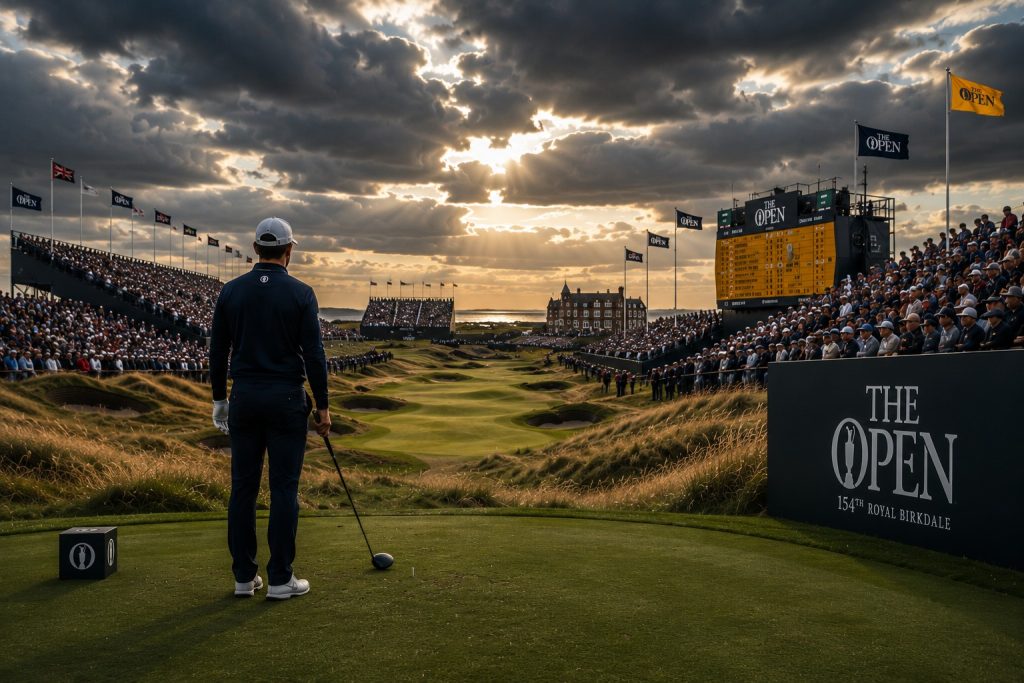
Our prediction is Scottie Scheffler to win The Open Championship 2026. Rory McIlroy is the leading alternative, Matt Fitzpatrick is the strongest form-based challenger and Collin Morikawa is the preferred dark-horse candidate.
Predicted Winner: Scottie Scheffler
Scheffler is the selection because his advantage is built on the least volatile part of professional golf: elite tee-to-green performance. Royal Birkdale requires accurate approaches, controlled driving and the ability to recover without turning one missed shot into a double bogey. Those requirements align closely with the strongest areas of his game.
He also leads both the Official World Golf Ranking and the Data Golf Ranking entering championship week. Data Golf assigns him the highest published pre-tournament winning probability at 8.8%, ahead of every other player in the field.
The main uncertainty is putting. Scheffler does not need to lead the field on the greens, but he is unlikely to win if he repeatedly fails to convert the opportunities created by his long game. A neutral putting week should be sufficient to keep him in contention through Sunday.
Best overall performance base
Scheffler enters as the highest-rated player in the principal global performance rankings used in this analysis.
Royal Birkdale-compatible long game
His approach quality and controlled tee-to-green performance should remain valuable on both positional and distance-demanding holes.
Low dependence on one skill
Scheffler can remain competitive through ball-striking, recovery play and mistake avoidance even without an exceptional putting performance.
Proven major resilience
His major record provides evidence that his underlying performance can withstand difficult setups and sustained championship pressure.
Projected Top 10
The projected leaderboard ranks players by their expected tournament performance rather than attempting to predict an exact final score. Small differences between adjacent positions should not be interpreted as decisive.
| Projected position | Player | Open Index | Confidence | Primary reason |
|---|---|---|---|---|
| 1 | Scottie Scheffler | 91 | High | Strongest complete tee-to-green and major profile |
| 2 | Rory McIlroy | 87 | High | Elite ceiling, links experience and long-game quality |
| 3 | Matt Fitzpatrick | 84 | High | Current form, accuracy and approach precision |
| 4 | Tommy Fleetwood | 82 | Medium | Exceptional links suitability and controlled ball flight |
| 5 | Jon Rahm | 80 | Medium | Power, trajectory control and major-winning resilience |
| 6 | Cameron Young | 79 | Medium | High long-game ceiling and scoring potential |
| 7 | Aaron Rai | 77 | Medium | Accuracy, controlled approaches and mistake avoidance |
| 8 | Collin Morikawa | 76 | Medium | Proven Open-winning iron play |
| 9 | Wyndham Clark | 75 | Medium | Recent major-level evidence and controlled power |
| 10 | Russell Henley | 74 | Medium | Accuracy, scrambling and low-error scoring |
Data Golf’s current headline probabilities place Scheffler first at 8.8%, McIlroy second at 5.8% and Fleetwood third at 5.3%. The Open Index agrees on Scheffler and McIlroy as the two strongest candidates but places Fitzpatrick ahead of Fleetwood because of the balance between current performance, approach quality and mistake avoidance.
Best Dark-Horse Candidate
Collin Morikawa
Morikawa’s approach precision is one of the clearest transferable skills in the field, and he has already demonstrated that it can produce an Open victory. His lower rating reflects recent inconsistency rather than a weak Royal Birkdale fit.
Russell Henley
Henley offers a high-floor combination of driving accuracy, scrambling and disciplined scoring. His most realistic path is a steady accumulation of pars and controlled birdie opportunities.
Viktor Hovland
Hovland can rise well above his ranking if his driving supports his approach play. The upside is substantial, but the risk of costly bunker trouble makes the projection less stable.
What Could Change the Prediction?
The current forecast indicates predominantly dry championship conditions with limited rain risk and moderate gusts. That supports the present weighting toward controlled ball-striking, but Royal Birkdale can still change significantly if the wind strengthens or the course becomes firmer than expected.
- Stronger-than-forecast wind McIlroy, Fleetwood, Rahm and other experienced links players would gain relative value through trajectory control and shot-making.
- Extremely firm greens and fairways Fitzpatrick, Rai, Morikawa and Henley would benefit from the increased emphasis on precision and predictable distance control.
- Softer conditions Longer hitters such as McIlroy, Rahm, Young and Clark could attack more aggressively without the same risk of drives running into distant bunkers.
- A major difference between tee-time waves The final leaderboard probabilities would move toward players who receive calmer conditions across the first two rounds.
- An exceptional putting week A contender outside the leading statistical group could overcome a long-game disadvantage and create a result that the pre-tournament model cannot fully anticipate.
The Open Index is an editorial prediction model, not an official ranking or guarantee of tournament performance. Golf outcomes are highly variable, and the majority of the total winning probability remains distributed across players outside the top individual selections.
- Data Golf – Current Open Championship predictions and rankings
- Official World Golf Ranking – Current world ranking
- Data Golf – Global player rankings
- Data Golf – Open Championship history and course insights
- The Open – Official championship field
- The Open – Official tee times
- Met Office – Royal Birkdale weather forecast
Championship Week Updates
Championship week has already produced one significant field change, the completion of the inaugural Last-Chance Qualifier and a clearer picture of how Royal Birkdale is likely to play. The course has been affected by sustained summer heat, creating firm, fast-running conditions ahead of the opening round.
The latest developments strengthen the importance of accurate positioning, trajectory control and judging how far the ball will run after landing. They do not materially change the leading Open Index contenders, but they increase the potential value of experienced links players and precise ball-strikers.
Louis Oosthuizen has withdrawn because of a back injury, Aldrich Potgieter has entered the field as his replacement, and Joe Dean secured the final available place by winning the Last-Chance Qualifier. Royal Birkdale is currently expected to play firm and fast under predominantly dry conditions.
Field Changes and Withdrawals
Louis Oosthuizen
The 2010 Champion Golfer withdrew because of a back injury. Oosthuizen has one victory and six runner-up finishes in men’s major championships, making his absence one of the most notable field changes of the week.
Aldrich Potgieter
Potgieter entered the championship as the first alternate after Oosthuizen’s withdrawal. His power creates considerable upside, although Royal Birkdale will test his ability to select conservative targets when fairway bunkers restrict the value of driver.
Joe Dean
Dean claimed the final place in the field by shooting a two-under 68 in the inaugural 18-hole Last-Chance Qualifier. An eagle at the par-5 14th proved decisive as he finished one stroke ahead of Andrew Wilson.
Dean returns to Royal Birkdale
This is Dean’s third Open appearance. He finished tied 70th at Royal Birkdale in 2017 and tied 25th at Royal Troon in 2024, giving him more relevant championship experience than a typical final qualifier.
| Player | Status | Reason or route | Prediction impact |
|---|---|---|---|
| Louis Oosthuizen | Withdrawn | Back injury | Removes an experienced former champion and links specialist |
| Aldrich Potgieter | Added to field | First alternate | Adds a powerful but comparatively volatile outsider |
| Joe Dean | Qualified | Last-Chance Qualifier winner | Adds a player with previous Royal Birkdale and Open experience |
Weather and Course-Condition Updates
The course has taken on a dry, straw-coloured appearance following a period of hot summer weather. Fast-running fairways should create additional rollout, while firm surfaces will make the precise landing point of each shot more important than its carry distance alone.
The official championship forecast continues to indicate predominantly warm and dry conditions. Coastal gusts remain the most important weather variable because even moderate wind can change which bunkers are reachable and whether long approaches will stop on firm greens.
| Condition | Likely effect | Players most likely to benefit |
|---|---|---|
| Firm fairways | More rollout and greater risk of reaching distant bunkers | Accurate drivers and players comfortable using less than driver |
| Firm greens | Smaller effective targets and greater emphasis on landing angle | Elite approach players with strong distance control |
| Dry run-off areas | More recovery options from tightly mown turf | Creative links players with varied short-game techniques |
| Coastal gusts | Greater variation in trajectory, club selection and bunker reach | Players with proven wind performance and controlled ball flight |
How the Latest Information Affects the Predictions
The confirmed developments do not change the predicted winner. Scottie Scheffler remains the Open Index leader because his tee-to-green advantage and mistake-avoidance profile remain highly relevant in firm, fast conditions.
Scheffler’s missed cut at the Genesis Scottish Open is a legitimate short-term concern, but it does not outweigh the much larger performance sample that placed him first in the principal global rankings. The result slightly narrows his advantage rather than removing him from the top position.
- Scottie Scheffler remains the predicted winner One missed cut introduces form uncertainty, but his broader tee-to-green evidence remains stronger than that of the field.
- Precision players gain marginal value Firm surfaces support the profiles of Matt Fitzpatrick, Aaron Rai, Collin Morikawa, Russell Henley and Corey Conners.
- Links specialists remain dangerous Rory McIlroy, Tommy Fleetwood and Jon Rahm can benefit if the wind becomes more influential than currently forecast.
- Power requires greater discipline Cameron Young, Wyndham Clark, Bryson DeChambeau and Aldrich Potgieter must prevent added rollout from carrying tee shots into strategically placed hazards.
- Joe Dean enters as an informed qualifier His Last-Chance Qualifier victory and previous Royal Birkdale appearance provide useful local and championship evidence, although he remains a long-shot contender.
Frequently Asked Questions
The following answers cover the most important questions about The Open Championship 2026, Royal Birkdale and the data-driven predictions in this article.
When is The Open Championship 2026?
The four championship rounds will be played from Thursday, July 16, through Sunday, July 19, 2026. The full event week runs from July 12 to July 19 and includes four practice days before competitive play begins.
Where is The Open Championship 2026 being played?
The 154th Open is being played at Royal Birkdale Golf Club in Southport, Merseyside, England. This will be the 11th time Royal Birkdale has hosted the championship.
The links course is located close to the Irish Sea and is known for dune-lined fairways, deep revetted bunkers and exposed coastal conditions.
Who is the favorite to win The Open Championship 2026?
Scottie Scheffler is the leading favorite in this analysis. He enters championship week as the defending Champion Golfer, the world’s top-ranked player and the highest-rated contender in the Open Index.
Rory McIlroy is the closest alternative. Matt Fitzpatrick and Tommy Fleetwood form the next group because their current performance, approach quality and links-course suitability fit Royal Birkdale particularly well.
Which statistics matter most at Royal Birkdale?
The most relevant indicators are approach performance, positional driving, bogey avoidance, links-course results and performance in windy conditions. Scrambling and long-iron play also matter because several holes require demanding approaches from extended distances.
Driving distance remains useful, but it is less valuable when a powerful tee shot finishes in one of Royal Birkdale’s deep fairway bunkers. The best profile combines sufficient distance with accurate placement and controlled trajectory.
What type of player suits Royal Birkdale?
Royal Birkdale generally suits a complete and tactically disciplined ball-striker. The ideal contender can control the height and shape of approach shots, select conservative targets when necessary and recover from tight lies or deep bunkers.
Players who depend entirely on driving distance or a short-term putting streak carry greater risk. The course repeatedly asks competitors to balance aggression with positioning over all 72 holes.
Who is the defending Open champion?
Scottie Scheffler is the defending Champion Golfer of the Year. He won the 2025 Open at Royal Portrush by four strokes after reaching 17 under par.
Scheffler is attempting to become the first player since Padraig Harrington in 2008 to win consecutive Open Championships. Harrington’s successful title defence also came at Royal Birkdale.