
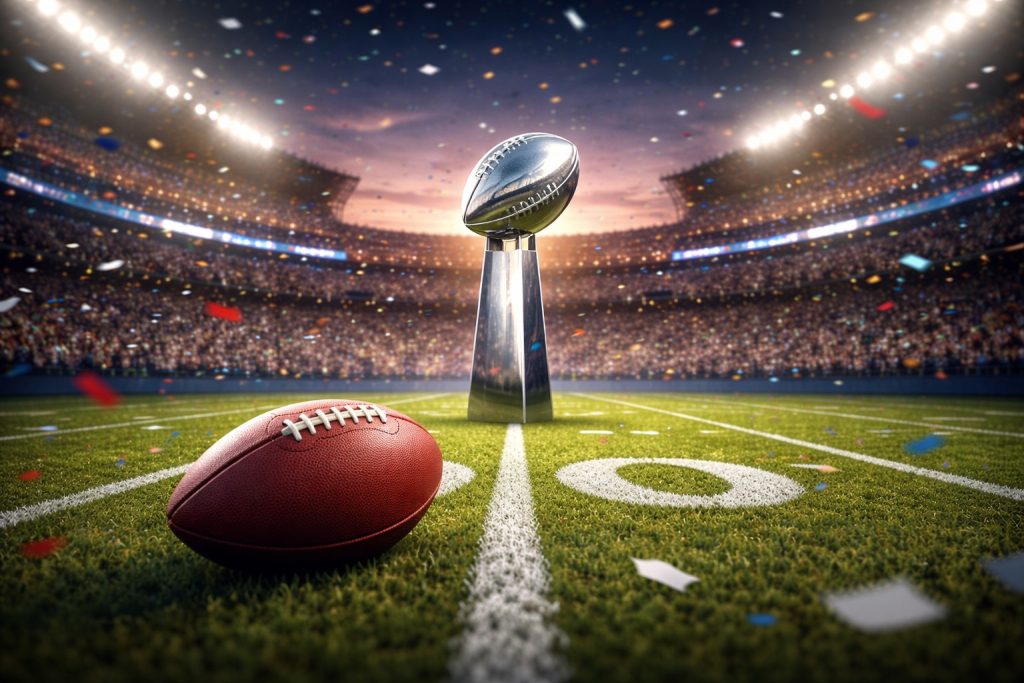
One game decides everything.
Super Bowl LX is where the NFL season reaches its final moment.
Super Bowl LX brings the league’s two best teams together for a single night that defines an entire season. Every possession carries weight, every decision is magnified — and there is no second chance.
Beyond the football itself, the Super Bowl is a global spectacle: kickoff times across time zones, the halftime show, and wall-to-wall coverage that turns the game into one of the most watched events of the year.
The game
1. Teams & season context
Super Bowl LX brings the NFL season to its final matchup. Two conference champions arrive at a neutral venue after navigating a long regular season and the pressure of the playoffs. What remains is a single game where the entire year is judged.
This context matters. Super Bowls are rarely won by the team that simply looks best on paper. They are won by teams that stayed composed under playoff pressure, adapted week to week, and survived opponents designed to expose their weaknesses.
| Conference | Team | Primary strength | Key question |
|---|---|---|---|
| AFC | New England Patriots | Game control, situational discipline | Can they stay patient if early momentum turns? |
| NFC | Seattle Seahawks | Tempo, physical pressure | Can they dictate pace without forcing errors? |
Why season context matters
The road to the Super Bowl filters teams aggressively. Playoff football removes margin for error: short preparation weeks, opponents with specific game plans, and constant pressure situations.
Teams that reach the Super Bowl are rarely flawless. They are resilient. They win despite injuries, momentum swings and uncomfortable matchups — and that resilience usually shows up again on Super Bowl Sunday.
The game
2. Key storylines that will decide the game
Super Bowl games are usually decided long before the final drive. The difference shows up in repeat situations: how offenses handle pressure, how defenses force uncomfortable decisions, and which team controls the game when the script breaks.
1) Early drives: who sets the terms
The opening possessions matter more than the scoreboard suggests. Coaches script the first series to test matchups, protection schemes and defensive communication. The team that wins early leverage often controls tempo for the rest of the half.
Watch for quick third downs, protection issues or early audibles. Those details reveal which side is reacting — and which is dictating.
2) Pressure without blitzing
In Super Bowls, defenses rarely live off heavy blitzing. The real advantage comes from generating pressure with four rushers while keeping coverage intact behind it.
When quarterbacks are forced to hold the ball an extra beat, timing routes break down and mistakes follow — even without sacks. This is often where turnovers are created.
What to watch live
- Clean pockets: offense stays on schedule
- Crowded throwing lanes: hesitation begins
- Late throws: interception risk rises
3) Third-and-medium situations
Third-and-short favors the offense. Third-and-long favors the defense. Super Bowls are decided in between — third-and-four to third-and-six.
These downs force quarterbacks to make tight-window throws and coordinators to choose between aggression and safety. Repeated failures here quietly flip field position all night.
4) Red zone play selection
Inside the 20-yard line, space disappears and execution is exposed. Successful Super Bowl offenses rarely rely on a single concept. They use motion, misdirection and patience to force defensive errors.
Settling for field goals keeps the opponent within reach. Touchdowns change play-calling on both sidelines.
5) Second-half adjustments
The Super Bowl is often decided after halftime. Defensive alignments tighten, coverage disguises change and offenses are forced to win differently than planned.
The team that adjusts first — not the one that sticks to the script — usually controls the third quarter.
A useful rule of thumb: if one team consistently wins third downs and finishes drives in the red zone, the final score usually reflects it — even if the game feels close for three quarters.
Timing & format
3. Kickoff time & time zones
Unlike most regular-season NFL games, the Super Bowl is a global appointment. Kickoff time matters not only for fans in the stadium, but for millions watching across different time zones — often late at night or early in the morning.
Super Bowl LX will kick off in the early evening in the United States, following the traditional Super Bowl schedule. The exact kickoff is usually set for around 6:30 pm Eastern Time (ET).
For international viewers, that timing changes the viewing experience significantly. In Europe, the game starts late on Sunday night; in parts of Asia and Australia, it becomes a Monday-morning event.
That global spread is part of what makes the Super Bowl unique: one game, watched live across almost every continent, all synced to the same kickoff.
Why kickoff timing shapes the game day
The long pregame window, extended halftime, and late finish are all built around that kickoff slot. Players deal with a different rhythm than on a normal Sunday, while fans settle in for an event that often stretches well past four hours.
Knowing the kickoff time — and what it means locally — is the first step to planning Super Bowl Sunday (or Monday) properly.
Timing & format
4. How the Super Bowl game day works
Super Bowl Sunday follows a rhythm that is very different from a regular NFL game. From the extended pregame coverage to the longer halftime, the entire day is built around a single kickoff — with football and spectacle deliberately intertwined.
Pregame: building momentum
Hours before kickoff, coverage shifts from analysis to anticipation. Lineups are confirmed, storylines sharpen, and the broadcast slowly transitions from studio discussion to stadium atmosphere.
For the teams, this extended buildup changes preparation. Warm-ups start earlier, routines are longer, and managing focus becomes part of the challenge.
Four quarters — but a different pace
Once the game begins, the structure is familiar: four quarters of football. What changes is the pacing. Commercial breaks are longer, reviews take more time, and momentum swings can feel more dramatic because of the stop-start rhythm.
Halftime: more than a break
Unlike a standard NFL halftime, the Super Bowl halftime is significantly longer. That affects both sides: players must cool down, then restart physically and mentally, while coaches adjust game plans during an unusually extended pause.
This interruption can reset momentum entirely. Teams that manage the restart well often look sharper in the third quarter, while others struggle to regain their rhythm.
Postgame: ending the season
Once the final whistle blows, the season ends immediately for both teams. The trophy presentation, interviews, and on-field reactions are all part of the event — and part of what separates the Super Bowl from any other NFL game.
One practical takeaway: Super Bowl games usually last longer than regular NFL games. If you’re watching live, plan for a multi-hour event from kickoff to final celebration.
Beyond football
5. Halftime show & entertainment
The Super Bowl halftime show has evolved from a simple intermission into a strategic part of the NFL’s biggest event. While details for Super Bowl LX have not yet been officially announced, the role and structure of the halftime show are well established — and they matter both on and off the field.
How the halftime show became a global event
For decades, the Super Bowl halftime was treated as background entertainment. That changed in the 1990s, when the NFL began positioning the break as a centerpiece designed to hold and expand the audience.
Since then, halftime performances have been built around mass appeal: artists with cross-generational recognition, short setlists, and production designed to work for both stadium spectators and television viewers.
Why the NFL keeps details secret for so long
Unlike the teams, the halftime show is not part of the competitive narrative. Announcing performers too early would shift attention away from the season itself. That’s why the league typically confirms the act only weeks before the game, once the football storylines are fully in place.
What halftime means for the game itself
From a football perspective, the extended halftime remains a competitive variable. Players cool down more than usual, coaches have extra time to adjust, and the restart becomes a mental checkpoint.
Many Super Bowls have turned on the opening series of the third quarter — not because of the show, but because one team managed the interruption better than the other.
Until official details are announced, the most reliable way to think about the halftime show is structurally: as a longer break that affects rhythm, focus and momentum — not as a distraction from the game itself.
Beyond football
6. Why Super Bowl commercials matter
Super Bowl commercials are not just advertising slots placed inside a football game. For brands, they are one of the most competitive and closely watched stages of the year — and for viewers, they have become part of the event itself.
Advertising under maximum attention
No other sporting event combines audience size, viewing duration and shared attention quite like the Super Bowl. Commercials air when viewers are already settled in, watching live, and unlikely to skip breaks.
That combination turns each advertising slot into a high-stakes moment. Brands are not competing with other programs — they are competing with each other inside the same broadcast, often within minutes.
Why brands accept the risk
Super Bowl advertising is expensive, but the goal goes beyond immediate sales. These commercials are designed to be discussed, replayed and shared, extending their reach far beyond game night.
Part of the Super Bowl experience
For many viewers, commercials are not interruptions on Super Bowl Sunday — they are moments to watch closely. Some ads become cultural reference points, remembered long after the final score fades.
This attention also feeds back into the broadcast itself. Commercial breaks feel shorter, momentum resets are sharper, and the game unfolds in a rhythm shaped by both sport and spectacle.
From a viewer’s perspective, the takeaway is simple: Super Bowl commercials matter because they are designed to be watched, not ignored — and because they reflect how unique this event truly is.
Watching worldwide
7. How to watch Super Bowl LX worldwide
Super Bowl LX is designed for live viewing. Because of its global audience, the game is broadcast across multiple regions with both television and streaming options available.
United States
In the United States, the Super Bowl is shown live on national television. Streaming access is typically available through the official broadcast partner and its authenticated digital platforms.
United Kingdom
In the UK, the Super Bowl is traditionally broadcast live on Sky Sports NFL. A free-to-air broadcast is also usually available via Channel 5.
Europe & international viewers
Across Europe and many other regions worldwide, the most consistent option is NFL Game Pass, which offers live coverage, full replays and condensed games depending on region.
Typical viewing options
- Live TV broadcast
- Official streaming platforms
- Full replays and highlights
- Postgame coverage and trophy ceremony
Because Super Bowl broadcasts run longer than regular NFL games, viewers should plan several hours from kickoff to the final presentation.
FAQ
8. FAQ: Super Bowl LX explained
When is Super Bowl LX played?
Super Bowl LX is scheduled for Sunday, February 8, 2026. Kickoff traditionally takes place in the early evening in the United States, which means late night or early morning viewing in many other parts of the world.
Why is the Super Bowl played at a neutral venue?
The Super Bowl is awarded years in advance to a host city. This ensures equal conditions for both teams and allows the league to plan infrastructure, security and global broadcasting well ahead of time.
How long does a Super Bowl game usually last?
While the game itself consists of four quarters, Super Bowl broadcasts are significantly longer than regular NFL games due to extended halftime, commercials and postgame coverage. Viewers should plan for several hours.
Is the Super Bowl different from a regular NFL playoff game?
Structurally, the game follows the same rules. What makes it different is the scale: extended media coverage, longer breaks, global viewership and the fact that it concludes the entire season.
Do you need to follow the NFL season to enjoy the Super Bowl?
No. While long-time fans appreciate the season-long context, the Super Bowl is designed to be accessible on its own — combining high-level competition with entertainment elements that make it engaging even for casual viewers.
In short: the Super Bowl works both as a championship game for dedicated fans and as a standalone global sports event for everyone else.