
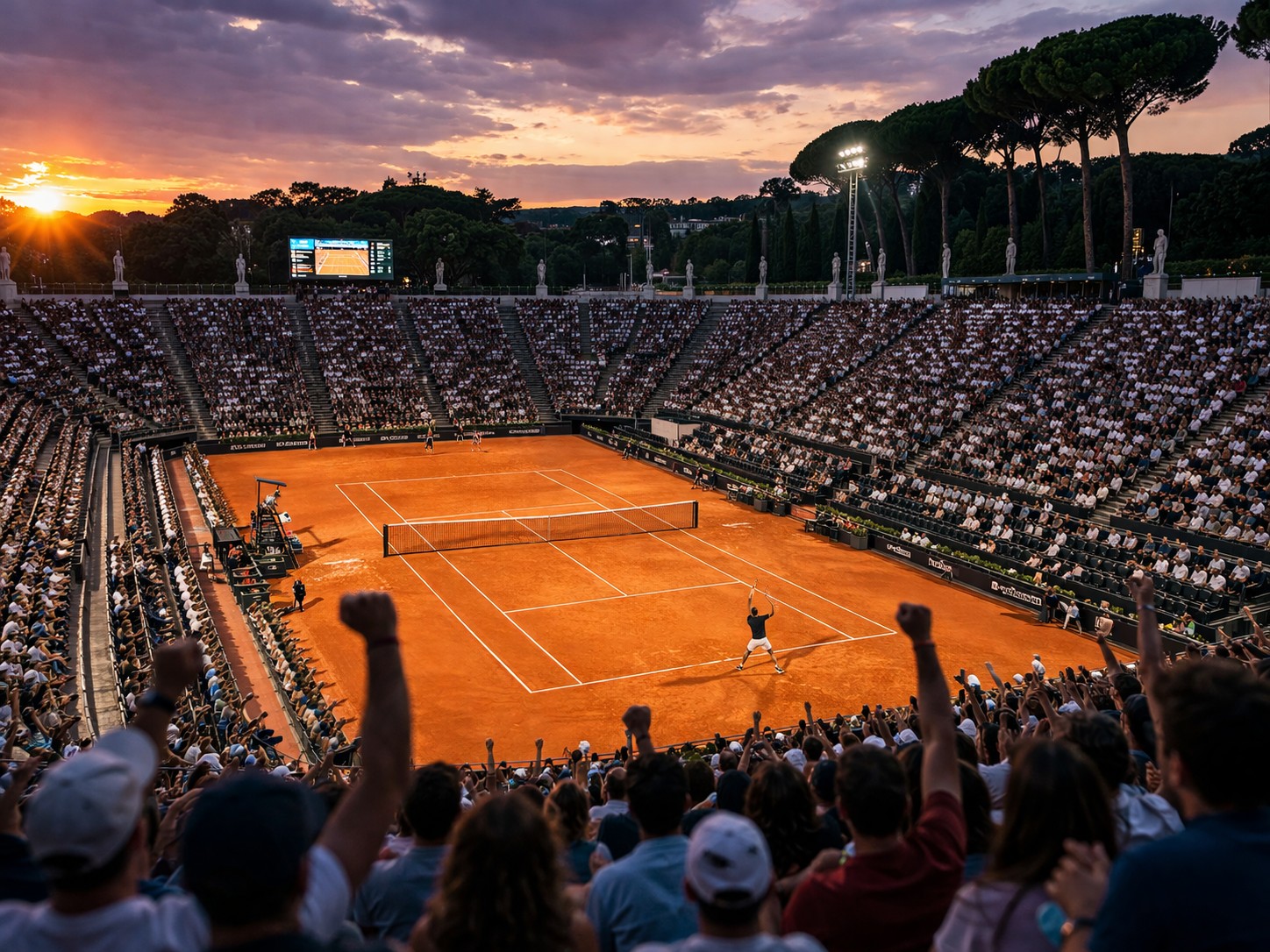
The Rome Masters 2026 is one of the most important tournaments of the clay-court season and serves as the final major test before the French Open. At the Foro Italico, the world’s best players from both the ATP and WTA tours compete under conditions that closely resemble those in Paris. Who stands out on the slower clay? Which players and players are emerging as favorites? And what can Rome really tell us about Roland Garros? This preview provides a complete breakdown, including analysis, key contenders and early predictions.
Quick Summary
- 🎾 The Rome Masters 2026 takes place at the Foro Italico and is part of the ATP Masters 1000 and WTA 1000 series.
- 📅 The tournament runs from early May to mid-May, just days before the French Open.
- 🧱 Matches are played on outdoor clay courts under conditions very similar to Roland Garros.
- ⭐ Several top players enter the event in strong form, with no clear dominant favorite in either field.
- 🔥 Rome is widely considered the most important preparation event for the French Open.
- 📊 Performance on slower clay and physical consistency are key factors for success.
- 🧠 Early predictions point to a highly competitive tournament with multiple realistic title contenders.
Tournament Overview
The Rome Masters 2026, officially known as the Internazionali BNL d’Italia, is one of the most prestigious events of the clay-court season. The tournament features both ATP Masters 1000 and WTA 1000 competitions, bringing together the world’s top players just weeks before Roland Garros.
Played at the iconic Foro Italico in Rome, the event serves as the final major benchmark ahead of the French Open. With slower conditions and physically demanding rallies, performances here often provide a strong indication of who is ready to compete for the title in Paris.
Key Facts
| Tournament | Internazionali BNL d’Italia 2026 |
| Location | Foro Italico, Rome |
| Surface | Outdoor clay |
| Category | ATP Masters 1000 & WTA 1000 |
| Dates | May 4 – May 17, 2026 |
| Significance | Final major preparation event before the French Open |
Why It Matters
Rome is more than just another stop on the tour. It is the closest simulation of French Open conditions outside Paris. Players who perform well here demonstrate not only strong form, but also the tactical discipline and physical endurance required to succeed in Grand Slam competition on clay.
Why Rome Matters for Roland Garros
The Rome Masters is widely regarded as the most reliable indicator for success at Roland Garros. Unlike other clay-court events, the conditions in Rome closely mirror those in Paris, making it the final and most meaningful test before the second Grand Slam of the season.
The slower surface, higher bounce and physically demanding rallies force players to rely on tactical discipline and endurance. These are exactly the qualities required to win matches over five sets in Paris.
Key Insight
Players who succeed in Rome typically excel in long rallies, maintain consistency under pressure and adapt tactically. These are the same attributes that often decide matches at Roland Garros.
Favorites
There is no clear dominant favorite heading into Rome. In both the ATP and WTA fields, several players have realistic chances of winning the title. Form, physical condition and adaptability to slower clay will ultimately determine who stands out.
ATP – Top Contenders
Jannik Sinner: One of the most consistent players on tour right now. Especially dangerous when he controls the tempo and dictates rallies.
Carlos Alcaraz: The most complete clay-court player in the field. Explosive, versatile and tactically flexible.
Novak Djokovic: Experience and consistency keep him among the top contenders. Particularly dangerous in long, high-pressure matches.
ATP – Challengers
Alexander Zverev: A strong baseline player who thrives in longer rallies, but heavily reliant on a consistent serve.
Holger Rune: Aggressive and unpredictable. Capable of beating anyone, but equally vulnerable to inconsistency.
WTA – Top Contenders
Iga Świątek: The benchmark on clay. Her combination of spin, control and consistency makes her the player to beat.
Aryna Sabalenka: Extremely aggressive. If she manages her error rate, she becomes one of the most dangerous players in the draw.
Elena Rybakina: A powerful and efficient player who continues to improve on clay.
WTA – Challengers
Jasmine Paolini: A dangerous player in Rome, especially with home support behind her.
Coco Gauff: Strong defensively with improving offensive tools, making her a serious threat on clay.
Analysis & Prediction
The Rome Masters 2026 follows a clear pattern across both tours: players who control rallies from the baseline and maintain physical consistency over long matches have a decisive advantage. The conditions reward structure, patience and tactical discipline rather than pure aggression.
Key Thesis
The title in Rome is won from the baseline – not with serve dominance.
ATP Prediction
The highest probability for the title lies within the Sinner–Alcaraz group, as both combine controlled aggression with tactical flexibility. Djokovic remains the most dangerous contender for a deep run, particularly if matches become physically demanding and strategically complex.
WTA Prediction
Świątek enters the tournament as the benchmark on clay, with her consistency and control giving her a structural advantage over the field. Players like Sabalenka and Gauff can challenge her, but only if they reduce errors and sustain their level over extended rallies.
Key Takeaway
Reaching the semifinals or final in Rome is one of the strongest indicators of Grand Slam readiness. Players who go deep here almost always enter Roland Garros as serious title contenders.
Schedule & Format
The Rome Masters follows the standard structure of ATP Masters 1000 and WTA 1000 events. With a large draw and staggered entry for seeded players, the tournament unfolds in clearly defined phases over nearly two weeks.
Top seeds receive a first-round bye, meaning they enter in the second round. This creates an interesting dynamic: early rounds often feature unpredictable matchups, while the biggest clashes are typically concentrated in the second week.
Understanding Tournament Dynamics
The first week is often about adaptation and rhythm, especially for top players entering later. The second week is where the tournament truly takes shape: from the quarterfinals onward, matches are typically decided by small margins such as physical endurance, match fitness and mental resilience.
Players to Watch
Beyond the main contenders, several players stand out due to their current form, tactical development or unique position heading into Roland Garros. These storylines often define the narrative of the tournament.
ATP – Players to Watch
Jannik Sinner – Can he sustain his form on slower clay?
Sinner arrives with strong momentum, but Rome presents a different challenge compared to faster conditions. The key question is whether he can maintain his aggressive baseline game over extended rallies.
Carlos Alcaraz – The most complete clay-court player?
Few players can vary pace and tactics as effectively as Alcaraz. His ability to switch between control and aggression makes him especially dangerous in Rome.
Novak Djokovic – The ultimate tournament player
Djokovic does not need perfect form to be a threat. His ability to adapt and peak during a tournament makes him particularly dangerous in later rounds.
Alexander Zverev – Consistency as the key factor
Zverev’s game suits the surface, but consistency remains the decisive factor. If he stabilizes his serve, he can challenge anyone.
Holger Rune – The unpredictable factor
Rune combines aggression with high risk. He has the potential to upset top players, but also carries volatility in his performances.
WTA – Players to Watch
Iga Świątek – The clay-court benchmark
Świątek remains the reference point on clay. Her control, consistency and tactical awareness make her the player everyone must beat.
Aryna Sabalenka – Power vs control
Sabalenka brings unmatched power, but her success on clay depends on controlling unforced errors and maintaining consistency in longer rallies.
Coco Gauff – Ready for the next step?
Gauff’s athleticism and defensive skills are among the best on tour. If her offensive game holds up, she can go deep in Rome.
Jasmine Paolini – Home advantage matters
As a local favorite, Paolini benefits from strong crowd support. In close matches, this can become a decisive factor.
FAQ – Rome Masters 2026
When does the Rome Masters 2026 start?
Qualifying begins on May 4, 2026. The main draw starts on May 5 (WTA) and May 6 (ATP).
When is the final played?
The finals take place on May 16 and May 17, 2026.
What surface is used in Rome?
The tournament is played on outdoor clay courts under conditions similar to those at Roland Garros.
Why is the Rome Masters so important?
It is the final major preparation event before the French Open. Players can test their form under realistic clay-court conditions.
Who are the favorites in 2026?
In the ATP field, Jannik Sinner, Carlos Alcaraz and Novak Djokovic are among the top contenders. In the WTA field, Iga Świątek leads the pack, with players like Aryna Sabalenka and Coco Gauff close behind.
Are there differences between ATP and WTA matches in Rome?
While the conditions are identical, match dynamics differ. ATP matches often feature longer rallies, while WTA matches tend to involve faster point construction and higher risk-taking.
Where can I watch the tournament?
Coverage depends on your region and is available via TV broadcasters and streaming platforms that hold ATP and WTA rights.
Conclusion
The Rome Masters 2026 is more than just another clay-court tournament. For both ATP and WTA players, it represents the most realistic test ahead of the French Open. The conditions demand a complete game: physical resilience, tactical clarity and consistent execution.
With multiple contenders in both fields and no clear dominant force, the tournament offers valuable insights into the current balance of power on clay. This makes Rome one of the most important indicators for what to expect in Paris.
Key Takeaway
Players who reach the semifinals or final in Rome are very likely to enter Roland Garros as serious title contenders in both the ATP and WTA competitions.
Looking Ahead to Paris
The coming days in Rome will reveal which players are already performing at Grand Slam level. The biggest winners will not only gain momentum, but also a crucial psychological edge heading into Roland Garros.
Ähnliche Beiträge / Similar Posts
 Victoria Mboko: The Next Big Thing in Women’s Tennis?
 Mboko vs. Osaka: A Hometown Hero Takes on a Grand Slam Great in Montreal Final
 US Open 2025 Preview: Key Storylines, Favorites and Rising Stars at Flushing Meadows
 ATP Finals 2025 Preview, Stats, Odds & Predictions
 Australian Open 2026: Full Preview, Schedule, Seeds, Favorites & TV Guide
 Victoria Mboko One Win Away: Previewing the Adelaide International Final