
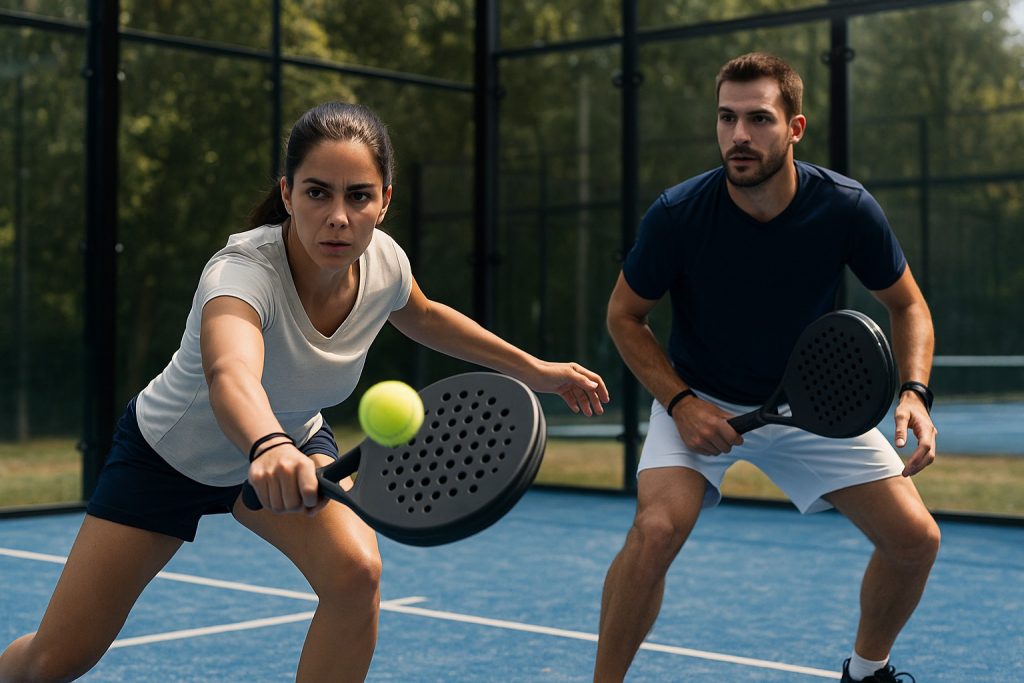
Padel is a racket sport usually played as doubles on an enclosed court with glass walls. It looks familiar to tennis players, but the walls, underarm serve and team positioning create a very different game.
How does a padel court work?
A regulation padel court is 20 metres long and 10 metres wide and is divided by a net.
Glass walls form part of the playing area, while metallic fencing is used around other sections.
If your opponent’s shot lands in your court first, the ball may then hit the back or side glass. You can still return it before its second bounce.
Your own return must first land legally in the opponent’s court before reaching their wall or fence.
The seven padel rules every beginner should know
Padel is normally played as doubles
Two players share each side of the court and should move as a pair.
The serve is underarm
The ball is bounced first and struck at or below waist height.
The serve goes diagonally
It must bounce inside the opponent’s diagonal service box.
The return of serve must bounce
You cannot volley the serve directly out of the air.
Only one floor bounce
The ball must be returned before it bounces on the floor a second time.
The glass stays in play
A ball can rebound from your glass after its first bounce and remain playable.
Volleys are allowed
Once the serve has been returned, players may take the ball before it bounces.
How do you serve in padel?
- Stand behind the service line.
- Bounce the ball inside your service area.
- Strike it at or below waist height.
- Keep at least one foot in contact with the ground.
- Send the ball diagonally across the net.
- Make sure it lands inside the correct service box.
How do the glass walls work?
The glass walls are usually the biggest conceptual difference for players coming from tennis.
Beginners often try to hit every ball immediately. In padel, letting a difficult ball reach the back glass can give you more time and control.
How does scoring work in padel?
A set is normally won by the first pair to reach six games with a two-game advantage. At 6–6, a tie-break is normally played. Matches are generally best of three sets.
Padel vs tennis: what is actually different?
| Feature | Padel | Tennis |
|---|---|---|
| Typical format | Doubles | Singles or doubles |
| Court | Enclosed | Open |
| Walls in play | Yes | No |
| Serve | Underarm after bounce | Overhead |
| Racket | Solid, no strings | Strung |
| Main tactical challenge | Space, net position, wall rebounds | Varies strongly by surface and style |
What equipment do you need?
Five tactical lessons for your first padel match
Think of an invisible rope connecting both players.
Net position gives you better attacking angles and reduces your opponents’ time.
A good lob can push opponents away from the net and help you move forward.
Do not panic when a difficult ball travels behind you.
Padel rewards patience and shot construction more than constant hard hitting.
Is padel physically demanding?
Padel is accessible to recreational players, but it involves repeated accelerations, changes of direction and explosive actions.
Scientific reviews have reported the elbow, knee, shoulder and lower back among commonly affected body regions in padel players, although the research base is still developing.
- Increase playing volume gradually.
- Warm up before matches.
- Learn controlled technique before chasing power.
- Use suitable footwear.
- Do not ignore persistent pain.
Why is padel growing so quickly?
According to the International Padel Federation’s 2025 World Padel Report, the sport had more than 35 million active players worldwide.
Several characteristics may help explain its appeal:
- compact playing area;
- doubles-based social play;
- familiar racket-sport concepts;
- long rallies;
- tactical depth created by the walls;
- relatively accessible entry for beginners.
These are plausible explanatory factors, not proof that any single factor caused the sport’s growth.
What should you focus on as a beginner?
Once those basics feel natural, more advanced shots such as the bandeja, vibora and aggressive overhead patterns become much easier to understand.
FAQ: quick answers about padel
Is padel easier than tennis?
Padel can be easier for complete beginners to start because the serve is underarm and doubles reduces the amount of court each player must cover. High-level padel is still technically demanding.
Can you play padel one against one?
Standard padel is played in doubles. Some facilities offer narrower singles courts, but this is not the normal competitive format.
Can the ball hit the glass in padel?
Yes. After the opponent’s shot bounces correctly in your court, it may rebound from the glass and remain playable.
Can you hit the ball directly against the opponent’s glass?
Not as a normal return. Your shot must first land correctly in the opponent’s court.
Is the padel serve underarm?
Yes. The ball is bounced first and then struck at or below waist height.
Does padel use tennis scoring?
The core system is similar: 15, 30, 40 and game. Competition-specific deuce formats can differ.
Conclusion: padel makes sense once you understand the walls
Padel looks familiar enough to tempt new players into treating it as a smaller version of tennis. That is the quickest way to misunderstand the sport.
The serve is different. The court is different. The positioning is different. Most importantly, the glass changes the geometry and rhythm of every rally.