
Introduction: Why the Form Guide Is the Key to Horse Racing
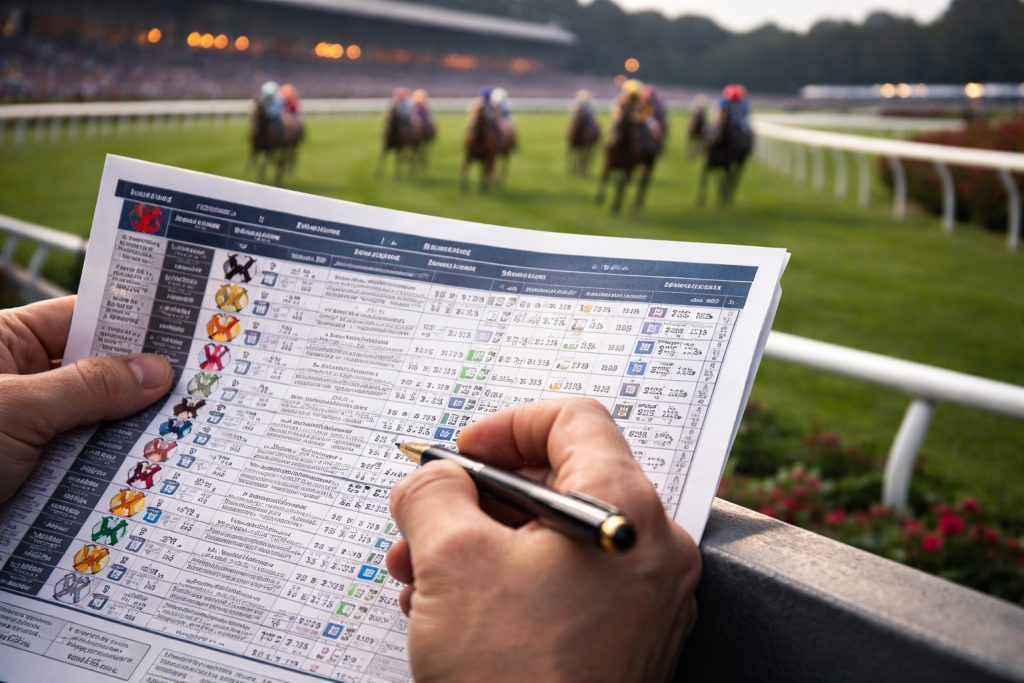
A horse racing form guide (often called a racecard) is far more than a list of runners and recent results. It is a condensed information system designed to help you understand the race itself, evaluate each horse’s past performance, assess how today’s conditions might influence the outcome, and interpret the signals sent by trainers, jockeys, and betting markets.
This guide shows you how to read a horse racing form guide like a professional. Instead of jumping between random statistics, you will learn a structured method that keeps every factor in its proper place. The result is clearer thinking, fewer mistakes, and more confident race analysis.
After reading this article, you will be able to:
- Understand every section of a horse racing form guide and what it represents.
- Separate past performance data from today’s race conditions.
- Interpret trainer, jockey, and betting market signals without overvaluing them.
- Combine all information into a clear and repeatable decision process.
Race Context – Understanding the Framework of the Race
Before analysing a single horse, professional bettors and analysts always start with the race itself. The race context defines the environment in which every runner must perform. Ignoring this step is one of the most common reasons form analysis goes wrong.
A form guide provides several layers of race-level information that apply equally to all runners. These details are not opinions or predictions; they are structural facts. Understanding them first ensures that later horse-specific analysis is interpreted correctly.
Race Type and Race Class
Race type tells you what kind of contest you are dealing with. Common race types include maidens, handicaps, conditions races, and stakes races. Each type has a different competitive logic and should be approached with a different analytical mindset.
Race class describes the quality level of the field. Higher-class races generally feature more consistent and proven horses, while lower-class races often include runners with uneven or unreliable form. A horse dominating in a low-class race does not automatically translate that performance to a stronger level.
- Maidens focus on potential rather than proven ability.
- Handicaps aim to equalise chances through weight assignments.
- Stakes and graded races prioritise pure ability and class.
Example
Imagine a racecard that says “Maiden”. Two runners have form lines like 6–4–3 and 9–7. In a maiden, these numbers often reflect learning rather than peak ability—especially for young horses. A “3” can be a strong run if the horse finished close to the winner and the race looked competitive, while a “9–7” horse might still improve sharply.
Distance, Track Layout and Surface
Distance is one of the most decisive structural elements in any race. Sprint distances reward early speed and positioning, while longer races test stamina, rhythm, and tactical patience. A form guide always lists the exact distance, often alongside past performances at similar trips.
Track layout adds another layer. Some tracks are tight and turning, others long and sweeping. Certain layouts favour front-runners, while others give closers more opportunity. Surface type—such as turf, dirt, or synthetic—further influences how races are run and how form translates.
- Sprints often exaggerate draw and pace effects.
- Longer distances reward proven stamina profiles.
- Surface changes can dramatically alter expected performance.
Prize Money and Competitive Level
Prize money is an underrated but highly informative part of race context. It often reflects the competitive importance of the race and the intent behind a horse’s entry. Higher prize money typically attracts stronger opposition and signals greater trainer ambition.
When reading a form guide, prize money should be viewed as a background signal rather than a selection tool. It helps you understand why a horse is running in a particular race and whether the event represents a realistic target or a stepping stone.
Horse Identity – Knowing Exactly What Horse You Are Evaluating
Once the race context is clear, the next step is to understand the horse itself. This section focuses exclusively on the horse’s identity—its fixed, structural characteristics. These details do not change from race to race, but they strongly influence how performance data should be interpreted.
A common mistake is to mix identity with performance. Identity tells you what kind of horse you are dealing with, not whether it will win today. Keeping this distinction clear is essential for disciplined form analysis.
Age, Sex and Career Stage
Age is one of the most important identity markers in a form guide. Horses develop physically and mentally over time, and their performance profiles change accordingly. Younger horses are often still improving, while older horses may be operating closer to their ceiling or in gradual decline.
Sex also matters. Colts, geldings, fillies, and mares can follow different career paths, influenced by physical development and breeding considerations. A form guide will always indicate sex, as it affects eligibility, weight conditions, and long-term expectations.
- Young horses are more likely to show rapid improvement or inconsistency.
- Prime-age horses tend to deliver their most reliable performances.
- Career stage helps explain gaps, layoffs, or changes in race placement.
Example
Two horses show similar recent form: 4–3–2. One is a 3-year-old with only four career starts. The other is a 7-year-old with forty starts. The form guide numbers look alike, but the interpretation is different: the younger horse is more likely to improve further, while the older horse is more likely to repeat a familiar level.
Pedigree and Breeding Indicators
Pedigree information offers clues about a horse’s natural strengths and limitations. Sires and dams often pass on tendencies related to distance preference, surface suitability, and running style. While pedigree does not replace performance data, it provides valuable context—especially for lightly raced horses.
In form guides, pedigree is most useful when a horse is trying something new, such as a longer distance or a different surface. Strong breeding indicators can justify improvement, while weak indicators can act as a warning sign.
- Stamina-oriented pedigrees often suit longer distances.
- Surface specialists frequently appear in bloodlines.
- Pedigree is most relevant early in a horse’s career.
Official Ratings and Long-Term Ability
Official ratings aim to summarise a horse’s overall ability into a single number. They are based on past performances and adjusted over time as new evidence becomes available. In a form guide, the rating acts as a reference point rather than a prediction.
Ratings are particularly useful for comparing horses across different races and conditions. However, they should never be viewed in isolation. A high rating does not guarantee success, just as a lower rating does not eliminate a horse from contention.
Historical Performance – Interpreting Past Results Correctly
After establishing the race context and the horse’s identity, the next step is to analyse what the horse has actually done on the racecourse. Historical performance data is the backbone of any form guide, but it is also the area where many readers draw the wrong conclusions. Past results must be interpreted, not taken at face value.
This section focuses purely on recorded outcomes and measurable performance indicators. It does not attempt to explain why a horse might improve or regress today. Keeping this separation clear helps avoid hindsight bias and overfitting past races to the present.
Form Lines, Symbols and Finishing Positions
Form lines provide a condensed snapshot of a horse’s recent finishing positions. They often appear as a sequence of numbers and symbols, sometimes accompanied by letters indicating incidents such as falls, pulled-up efforts, or disqualifications. While easy to read, form lines can be misleading if viewed without context.
A finishing position alone does not explain how competitive a run actually was. A narrow defeat in a strong race can be more informative than a comfortable win in a weak field. Professionals use form lines as an entry point, not a final verdict.
- Recent runs usually matter more than distant history.
- Context such as race class and conditions must always be considered.
- Inconsistency in form lines can signal volatility rather than lack of ability.
Example
A horse’s recent form reads 1–5–2. A quick glance suggests inconsistency. But if the “5” came in a noticeably stronger class (or on a different surface), the sequence can still indicate solid ability rather than erratic form.
Speed Figures, Ratings and Performance Metrics
Speed figures and performance ratings attempt to quantify how fast or how well a horse actually ran, independent of finishing position. These metrics adjust for variables such as distance, track conditions, and sometimes pace, offering a more comparable view across different races.
In a form guide, these figures are best used to identify performance trends. A horse consistently running close to its peak figure is generally more reliable than one showing extreme highs and lows. Single standout numbers should be treated with caution unless supported by repeat performances.
- Consistency often matters more than a single career-best figure.
- Figures are tools for comparison, not predictions.
- Different rating systems are not always directly comparable.
Class Movement and Consistency Patterns
Class movement describes whether a horse is moving up, down, or staying at the same competitive level. This information is crucial when interpreting past performances, as results are always relative to the strength of opposition. A modest finish in a higher class can be more encouraging than a win against weaker rivals.
Consistency patterns help distinguish reliable performers from unpredictable ones. Some horses deliver similar efforts race after race, while others fluctuate widely. Recognising these patterns allows you to adjust expectations and risk assessment accordingly.
Current Race Conditions – Evaluating Today’s Specific Setup
Once past performance has been assessed, the focus shifts to the present. Current race conditions describe how today’s setup may influence each runner, regardless of what happened in previous races. This is where many form guides gain their practical relevance, as small situational changes can have a significant impact on outcomes.
Unlike historical data, these factors are temporary. They apply only to this specific race and must be evaluated fresh each time. Treating them as a separate analytical layer helps prevent outdated assumptions from carrying too much weight.
Draw, Post Position and Track Bias
The draw, or post position, determines where a horse starts relative to the field. Depending on track layout and distance, certain positions can offer a tactical advantage. Inside draws may save ground on tight turns, while outside positions can allow a cleaner run in wider tracks.
Track bias refers to patterns that favour particular running styles or areas of the track. These biases can be temporary and subtle, which is why they should be used cautiously. When present, however, they can help explain unexpected results and refine expectations.
- Draw importance increases in short-distance races.
- Biases are most relevant when consistently observed.
- Post position should always be viewed alongside running style.
Example
Consider a short-distance sprint where a horse typically races prominently (near the front). If it is drawn very wide, it may need to use extra early energy to secure position. Now imagine the same race also contains several other confirmed front-runners: the likely pace becomes fast. In that setup, the “today” factors (draw + pace) can matter more than small differences in past finishing positions.
Going, Ground Conditions and Weather Impact
Going describes the condition of the racing surface, ranging from firm to heavy on turf, or fast to sloppy on dirt. Weather plays a direct role in shaping these conditions, often changing them shortly before race time. A form guide will usually indicate the official going, but understanding how horses respond to it is key.
Some horses show a clear preference for certain ground conditions, while others are more adaptable. Strong past performances on similar going can provide confidence, whereas untested or poor records can introduce uncertainty.
- Extreme going amplifies differences between runners.
- Surface changes can outweigh minor form advantages.
- Late weather updates should always be monitored.
Distance Suitability and Pace Scenario
Distance suitability reflects whether today’s trip aligns with a horse’s proven strengths. Even small changes in distance can alter race dynamics, particularly at the extremes of sprinting and staying trips. Form guides often highlight previous results at or near the current distance.
Pace scenario describes how the race is likely to be run. A fast early pace can favour horses that settle and finish strongly, while a slow pace may advantage front-runners. Anticipating pace helps translate static form data into a dynamic race picture.
- Pace matters more than raw distance alone.
- Running style determines how a horse experiences the pace.
- Uncontested leads can distort expected outcomes.
Weight Carried and Handicap Impact
In handicap races, weight is used to balance the field by asking stronger horses to carry more. The amount of weight assigned can influence speed, stamina, and late-race effectiveness, particularly over longer distances. Form guides clearly list the weight each horse will carry today.
Weight should not be viewed in isolation. Its impact depends on the horse’s physical profile, the race distance, and the expected pace. Subtle changes in weight can be meaningful when all other factors are closely matched.
Human and Market Factors – Signals Beyond the Horse Itself
Not all information in a form guide is directly tied to the horse’s physical ability or past performances. Human and market factors reflect decisions, intentions, and perceptions surrounding the race. These signals are indirect, but they can provide valuable context when interpreted carefully.
This layer of analysis is often misunderstood. Professionals treat it as supporting evidence rather than a primary selection tool. Used correctly, it helps confirm or question conclusions drawn from more objective data.
Trainer Form, Patterns and Intent
Trainers play a central role in race placement, preparation, and timing. A form guide often includes recent trainer statistics, such as strike rates or recent winners, which can offer insight into stable form.
Beyond raw numbers, patterns matter. Some trainers excel with first-time starters, others improve horses sharply after a layoff, and some target specific tracks or race types. Recognising these tendencies helps explain why a horse may be entered in a particular race.
- Short-term trainer form can fluctuate.
- Long-term patterns are more reliable than recent streaks.
- Intent is inferred, not guaranteed.
Jockey Bookings and Strike Rates
Jockey choice can signal expectations, especially when a stable has multiple runners or access to top riders. A high-profile booking may indicate confidence, while a lesser-known jockey does not automatically suggest low ambition.
Strike rates provide a statistical summary of jockey effectiveness, but they must be interpreted in context. Jockeys often ride horses of varying quality, which can inflate or depress headline numbers. The fit between jockey style and horse running style is often more important than raw percentages.
- Bookings can reflect stable priorities.
- Style compatibility matters more than reputation.
- Statistics describe history, not certainty.
Betting Odds, Market Moves and Public Perception
Betting odds represent the market’s collective opinion about a race. They incorporate public sentiment, professional analysis, and bookmaker adjustments. A form guide will usually display current odds and, in some cases, early price movements.
Market moves can be informative, but they should not override solid form analysis. Odds shorten and drift for many reasons, including volume of bets and media narratives. Professionals use the market as a sense check, not as a shortcut to selections.
Example
A horse opens at generous odds and then shortens significantly before the race. That move can reflect increased confidence, inside information, or simply public hype. A disciplined approach is to use the market move as a sense check: if the horse already fits your form-based shortlist, the move can reinforce your view; if it looks wrong on class or conditions, the market alone is not a reason to ignore red flags.
Putting It All Together – How Professionals Analyse a Form Guide
After breaking a form guide into clear, separate layers, the final step is synthesis. This is where professionals combine race context, horse identity, past performance, current conditions, and human and market signals into a single, coherent assessment. Importantly, this process does not introduce new information—it simply organises what is already known.
Professional analysis is not about finding the “perfect” horse. It is about reducing uncertainty, eliminating weak candidates, and understanding where the remaining runners truly stand relative to each other.
Weighting Factors and Eliminating Runners
Not all factors carry the same importance in every race. Professionals adjust the weight of each factor depending on race type, distance, and competitive level. For example, pace and draw may dominate short sprints, while stamina and class become more decisive over longer trips.
A key skill is early elimination. Instead of searching for reasons to include every runner, professionals actively look for valid reasons to rule horses out. This narrows the field and sharpens focus on realistic contenders.
- Eliminate horses unsuited by distance or going.
- Question runners facing unrealistic class jumps.
- Reduce reliance on marginal or contradictory signals.
Identifying Red Flags and Hidden Positives
Red flags are indicators that significantly increase risk. These can include repeated failures under similar conditions, unsuitable pace scenarios, or sudden changes in race placement that lack logical support. A single red flag may not be decisive, but multiple ones compound risk quickly.
Hidden positives often appear less obvious. Examples include quietly improving speed figures, subtle drops in class, or a return to preferred conditions. Spotting these requires patience and a willingness to look beyond headline results.
- Red flags increase risk rather than eliminate automatically.
- Hidden positives often explain market mispricing.
- Context determines whether a signal truly matters.
Winners vs Value Bets: Two Different Goals
Professional form analysis clearly separates the idea of picking the most likely winner from identifying the best betting opportunity. These are related but not identical objectives. The shortest-priced horse may be the most likely winner, but not necessarily the best value.
Value exists when the odds offered are higher than the true probability suggested by your analysis. Understanding this distinction allows form guides to be used flexibly, whether the goal is prediction, betting, or deeper race understanding.
Example
You have a 10-runner field. A professional-style synthesis might look like this:
- Eliminate horses clearly unsuited by distance or going (cut 10 → 6).
- Eliminate runners making unrealistic class jumps without supporting metrics (6 → 4).
- Prioritise horses with consistent figures or a clear improving trend (4 → 3).
- Use draw/pace to decide which of the final three has the cleanest likely trip.
- Check market signals last, as confirmation rather than a shortcut.
Common Mistakes Beginners Make When Reading Form Guides
Even with access to the same information, inexperienced readers often arrive at very different conclusions than professionals. The reason is rarely a lack of data; it is usually a series of predictable mistakes in how that data is interpreted and combined. Recognising these errors is one of the fastest ways to improve form reading skills.
The mistakes below are not about missing obscure details. They stem from mixing analytical layers, overreacting to single signals, or ignoring context that applies to the entire race.
Focusing on Finishing Positions Alone
One of the most common errors is treating finishing positions as definitive proof of ability. A first-place finish does not automatically indicate a strong performance, just as a poor finish does not always signal weakness. Without considering class, pace, and conditions, raw results can be highly misleading.
Mixing Past Performance with Today’s Conditions
Another frequent mistake is assuming that what happened before will repeat under different circumstances. Past performance describes what has already occurred, while current conditions define today’s environment. Confusing these layers leads to overconfidence in outdated or irrelevant form.
Overvaluing Trainer, Jockey, or Market Signals
Human and market factors are easy to overrate because they feel informative and intuitive. A popular jockey or a shortening price can create a false sense of certainty. When these signals override solid form analysis, they tend to increase risk rather than reduce it.
Trying to Explain Every Result
Not every performance has a neat explanation. Beginners often force narratives to justify unexpected outcomes, which can distort future analysis. Accepting uncertainty and incomplete information is part of disciplined form reading.
Ignoring Elimination as a Strategy
Many readers approach a race by searching for reasons to include horses rather than exclude them. This leads to crowded shortlists and unclear decisions. Effective form analysis works in the opposite direction, systematically removing runners that do not meet key criteria.
Conclusion: Reading Form Guides with Confidence and Clarity
A horse racing form guide is only as useful as the method applied to it. When read without structure, it becomes a source of confusion and false certainty. When approached systematically, it turns into a powerful framework for understanding races, evaluating horses, and managing uncertainty.
By separating race context, horse identity, historical performance, current conditions, and human and market signals, you avoid the most common analytical traps. Each layer answers a different question, and none of them needs to be overstretched to justify a conclusion. This clarity is what distinguishes disciplined form readers from casual observers.
With practice, this structured approach becomes intuitive. You will spend less time chasing isolated statistics and more time forming balanced assessments. Whether your goal is deeper understanding, sharper predictions, or more selective betting, reading form guides with confidence starts with respecting their structure.
The most important takeaway is simple: a form guide does not tell you what will happen. It helps you understand what is possible, what is likely, and where uncertainty remains. Used correctly, it becomes a tool for clearer thinking rather than definitive answers.